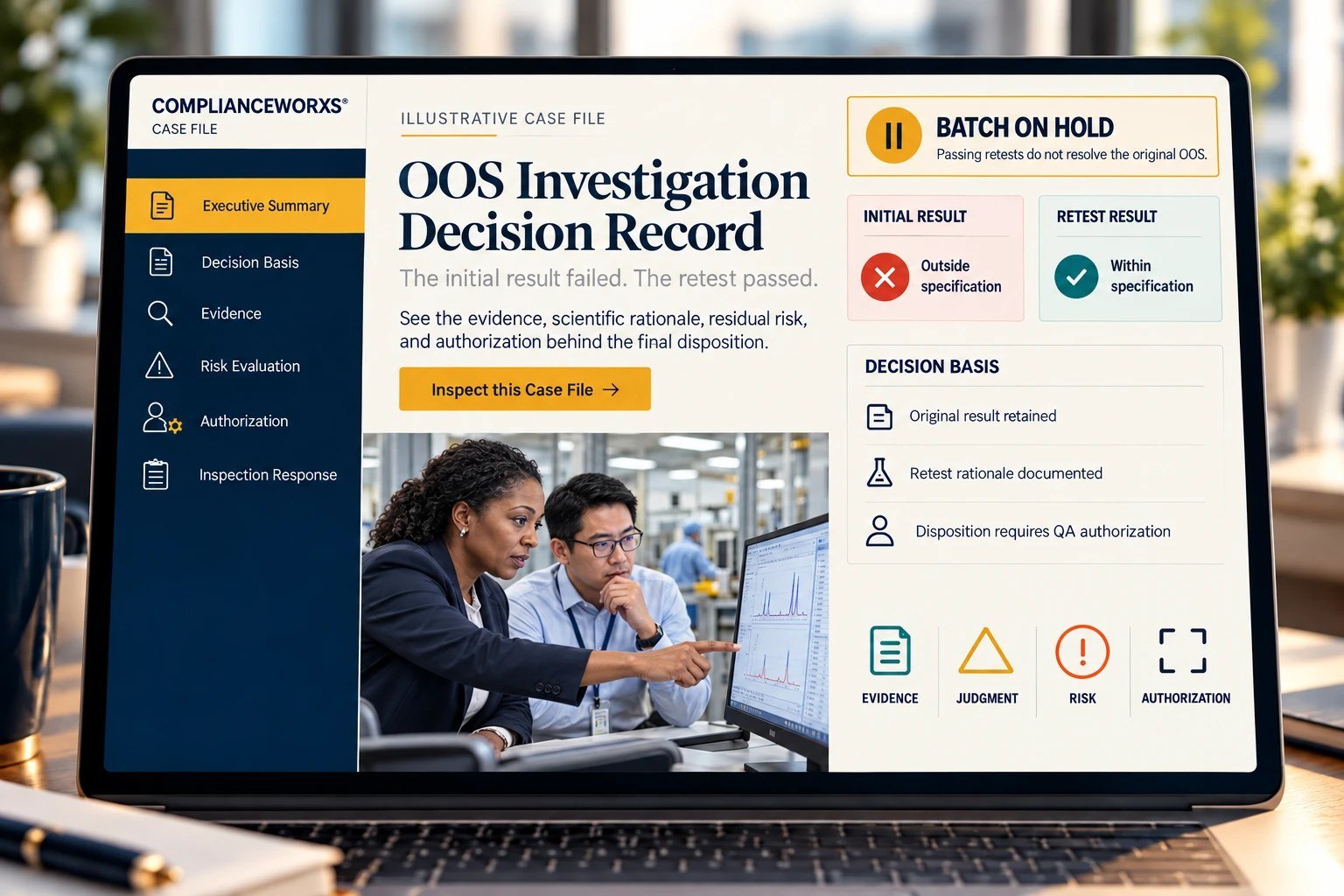
The initial result failed.The retest passed.What justifies the batch disposition?
A passing retest shows that a result inside the specification exists. The Case File shows what the disposition needs to preserve: what was found about the original failure, the plan the retest followed, the risk left open, and who had the authority to decide.
When the inspector asks why the retest counted and the first result did not, this is the record that answers.
Delivered after payment · private web edition and PDF
A page from the finished record
Read one finished decision record before you buy.
Illustrative case. This is an excerpt of the worked record inside the Case File: OOS-2026-0057, assay by HPLC, specification 90.0% to 110.0% of label claim.
DecisionRelease; original result retained, not invalidated
Original result 88.6%. Reproduced on re-injection of the same preparation (88.5% and 88.7%). Phase I laboratory assessment LA-2026-0057 found no assignable cause.
Retests 99.0%, 98.8% and 99.2%. Three independent preparations by a second analyst, under protocol RT-2026-0057, approved by QA before testing.
The original was reported with the retests. None was averaged with it.
The conclusion, and what was rejected
Reject the lot. Rejected: the investigation did not establish that 88.6% reflected the quality of the lot, and the independent evidence pointed the other way.
Release on the retests alone. Rejected: with no laboratory error identified there was no basis to replace the original, and averaging would hide the gap between 88.6% and 99%.
Extend the hold and retest further. Rejected: the retest count was fixed in advance (SOP QA-044 §7.3) and not adjusted for results.
The risk left unresolved
The cause of the 88.6% was never found. Root cause stays open with the QC Laboratory Manager, due 14 August 2026, CAPA-2026-0112.
Subpotency risk. Lot on stability, assay at 3 and 6 months, owned by the Stability Coordinator, STB-2026-0057.
Reopen trigger. A stability assay below 95.0%, or a second unexplained OOS on this method in twelve months.
Who authorized the next action
Dana Whitfield, Director, Quality Assurance, under named authority, on a stated date and time.
The record shows who held the authority, what they relied on, and what risk they accepted. No one reconstructs it from memory.
What the full Case File adds
The whole record, not one page of it.
The complete worked record: context, evidence, judgment, risk and authorization in one document.
What was established, and what was only inferred.
The rules behind the question, including 21 CFR 211.192 and 211.165(f).
A private web edition and a PDF, delivered after payment.
A passing retest is not the same decision as the investigation behind it.
An OOS result can be investigated, retested, reported, and released with every signature in place without preserving what was found about the original failure, whether the retest followed a plan fixed in advance, or who accepted the risk that remained. The harder question is whether the record shows why the passing result was entitled to decide the batch, without anyone having to reconstruct it from memory.
The disposition record
What makes the OOS disposition explainable?
Evidence
The laboratory data, the Phase I assessment, the retest plan and results, other results on the lot, and the production review, each tied to the decision.
Judgment
Why the original result was kept, why the retests were or were not relied on, and why the disposition was justified.
Risk
The unexplained cause, subpotency over shelf life, the alternatives of reject, hold or release, and the residual exposure accepted.
[]
Authorization
Who held authority for the disposition, whether it was delegated, and the basis on which they accepted the risk.
Signals that should slow a disposition
Before dispositioning a batch after an OOS result, leadership should be able to answer more than “did the retest pass?”
Check your own OOS dispositions against these signals.
The original result is set aside or discounted, but the record does not show what laboratory error was confirmed, or what was checked and found.
Retest plan not fixed in advance
Retests were run, but the record does not show who decided how many, or when, so it cannot show testing did not continue until a result passed.
Original result left out
The disposition lists the passing results, but the original failing result is not reported beside them or explained.
Disposition authority not shown
The record does not show who held authority for the disposition, whether it was delegated, or what risk they accepted.
Your answers, and where the Case File answers them
Inside the $149 Case File
The retest passed. Now explain the disposition.
See how one worked example connects the evidence, the reasoning, and accountable Quality approval.
The setup · illustrative case
An inspector reviews an OOS investigation closed on a retest. The first assay was 88.6% against a 90.0% to 110.0% specification; two retests passed; the batch was released. The inspector asks what was wrong with the first result, why the retests decided the batch, and who accepted the decision. “No record responsive to any of these questions was produced.” Here is what the record would have said.
In the inspector’s chair
The inspector asks
“What was wrong with the first result, and what shows it?”
From the record’s Evidence Reviewed
Phase I laboratory assessment: analyst interview, raw data and chromatograms, calculation independently re-performed, system suitability met, standards and reagents in date, glassware and balance checks. No assignable cause identified.
Retained preparations re-injected: 88.5% and 88.7%, consistent with the original. The instrument is not the source, and this does not locate a preparation error.
Why it matters. It says what was checked, and that nothing was found. That is the answer the firm in this case could not produce.
The inspector asks
“Why did the passing results decide this batch?”
From the record’s Judgment
The retests did not decide the disposition. The original result was never invalidated, because no test event that could have caused it was observed and documented. It stayed in the record and was reported with the three retest results.
The decision rested on whether the full evidence showed that 88.6% did not reflect the quality of this lot: a retest plan fixed before testing and run by a second analyst, other lot data that pointed the same way, a production review with no aberration, and a twelve-lot history close to 99%.
Why it matters. The record separates the retests from the decision. The original result stays, and the disposition rests on the whole body of evidence.
The inspector asks
“Who authorized the disposition, and what risk did they accept?”
From the record’s Authorization
On the evidence reviewed, the original result does not reflect the quality of the lot, and I authorize release. The cause of the original result is unexplained and is assigned for follow-up. I accept responsibility for this disposition.
Dana Whitfield · Director, Quality Assurance 17 July 2026 · 15:20 EST
Why it matters. A name, an authority, a timestamp, and a sentence that accepts the unexplained cause. A QA signature confirms the page was reviewed; this is the authorization.
1 of 3
Get the Case File
Start with the finished disposition record.
The Case File is a worked example for leaders and review teams. It does not document your own OOS investigations. When an actual consequential decision needs its own record, the Inspection Response Record is built for that.