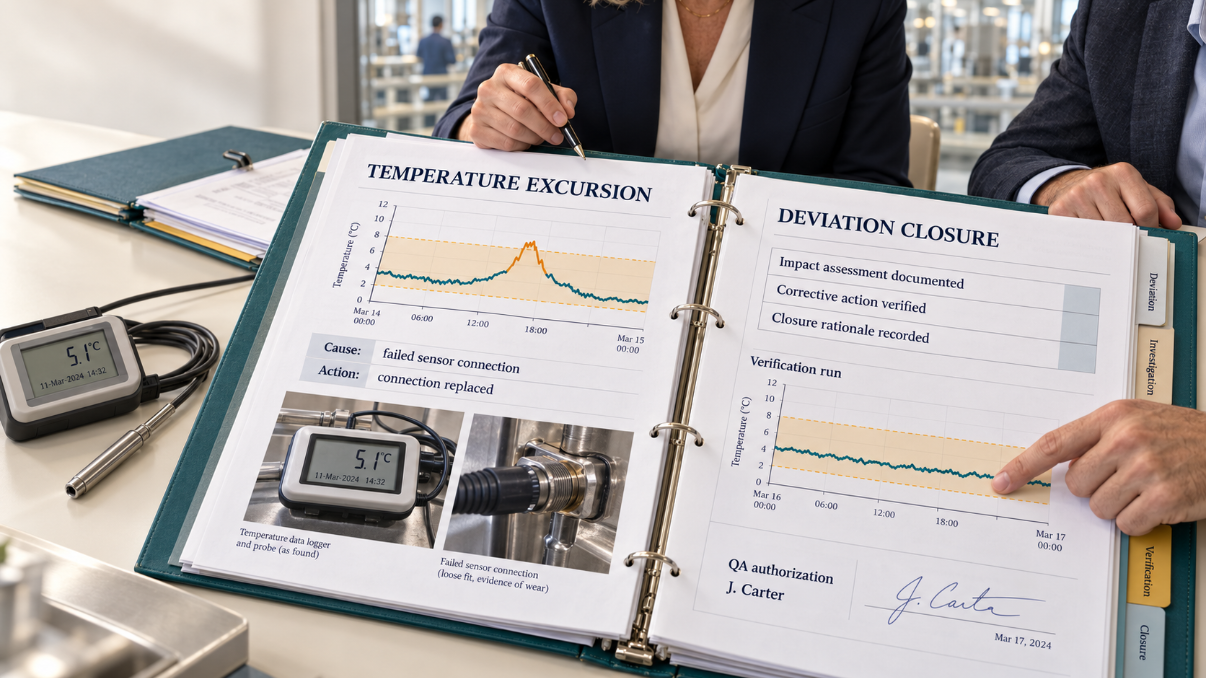
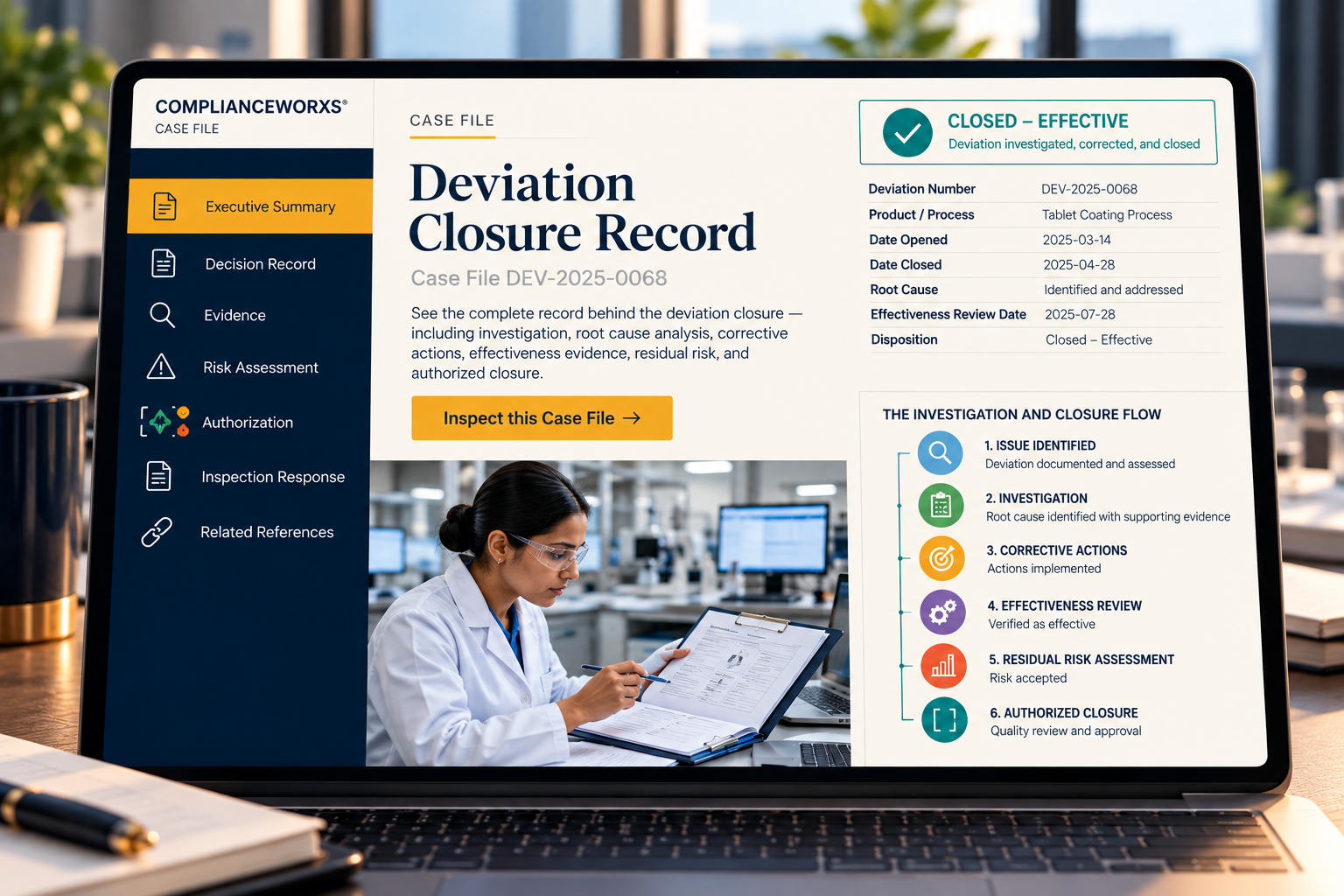
The deviation may be closed.Can you show why it was accepted?
A signed closure shows that a deviation was closed. The Case File shows what that decision needs to preserve: the evidence, the root-cause judgment, the risk left open, and who had the authority to close it.
When the inspector asks who accepted this closure and why, this is the record that answers.
Illustrative case. This is an excerpt of the worked record inside the Case File: DR-2023-0441, an aseptic-technique deviation at Fill Station 2, with the related action CAPA-2023-0118.
DecisionClose deviation; operator technique confirmed as cause
Equipment ruled out. Maintenance records, the preventive maintenance schedule and the 90-day performance history for Fill Station 2 show no equipment contribution.
A systemic cause ruled out. Environmental monitoring data stayed within limits, with no pattern of technique observations across other operators or stations.
Operator technique supported. Direct supervisor observation at Fill Station 2 and this operator’s own deviation history point to technique.
Product impact assessed. The two lots filled during the event window were assessed against in-process, environmental and release results; no adverse trend was identified.
The conclusion, and what was rejected
Close, with retraining as the corrective action. Equipment and a systemic cause were eliminated first, so targeted retraining was judged adequate for an isolated, operator-specific deviation.
Hold open for a broader systemic investigation. Rejected: the monitoring data and deviation history already addressed a systemic cause.
Close on “human error” without ruling out other causes. Rejected: a stated cause with no record of what was eliminated could not show why retraining, rather than an equipment or system response, was right.
The risk left unresolved
Whether the technique holds. The evidence did not establish that the improvement will persist beyond the three supervised fills. Owner: Aseptic Operations Supervisor, due 31 January 2024, CAPA-2023-0118.
Reopen trigger. A second aseptic-technique deviation by the same operator, or a technique finding at Fill Station 2 from any operator, in the next two quarters. Trigger owner: QA Compliance Lead.
Who authorized the closure
James Osei, Senior QA Manager, Aseptic Operations, under Quality Unit deviation closure authority, SOP QA-031 §8.2. Not delegated.
The record shows who held the authority, what they relied on, and what risk they accepted. No one reconstructs it from memory.
What the full Case File adds
The whole record, not one page of it.
One completed deviation-closure decision record: context, evidence, judgment, risk and authority in one document.
What was established, and what was only inferred.
The rules behind the question, including 21 CFR 211.192, 211.100(b) and 211.22(a).
A PDF, delivered after payment, with a 7-day secure download.
A signed closure is not the same decision as the investigation behind it.
A deviation can be fully investigated, the root cause entered, the actions complete, and the closure signature in place without preserving why Quality accepted the investigation as sufficient, what stayed uncertain, or who had the authority to close it. The harder question is whether the record shows the basis for closure without anyone having to reconstruct it from memory.
The closure record
What makes the closure decision explainable?
Evidence
Event facts, investigation records, testing, interviews, and process data the reviewer actually had in front of them.
Judgment
Why the investigation supported the root-cause, impact, and disposition conclusions, and why closure was justified.
Risk
Product impact, recurrence uncertainty, alternative explanations, and the residual exposure accepted at closure.
[]
Authorization
Who held closure authority, whether it was delegated, and the basis on which they accepted the investigation.
Signals that should slow closure
Before closing a deviation, leadership should be able to answer more than “is the investigation complete?”
A root cause is entered, but the record does not show which other explanations were considered and ruled out.
Product impact not evaluated
The deviation was closed, but the record does not show whether affected material or batches were assessed for impact.
Open uncertainty not recorded
Closure was accepted with questions still open, and the record does not say what they were or why they were acceptable.
Closure authority not shown
The record does not show who held closure authority, or whether it was delegated, when the deviation was closed.
Your answers, and where the Case File answers them
Inside the $149 Case File
The investigation is finished. Now explain the closure.
See how one worked example connects the evidence, the reasoning, and accountable QA approval.
The setup · illustrative case
An inspector reviews a deviation closed with a retraining CAPA and asks three questions. “No authorization record responsive to any of these questions was produced.” Two lots are placed on quality hold pending additional retrospective risk assessment. Here is what the record would have said.
In the inspector’s chair
The inspector asks
“What evidence was reviewed to eliminate systemic and equipment-based causes?”
From the record’s Decision Basis
Equipment-based cause eliminated: maintenance records, PM schedule, and 90-day performance history confirm no equipment contribution.
Systemic cause eliminated: EM data within limits; no pattern of technique observations across other operators or stations.
Operator technique as assignable cause supported by direct supervisor observation at Fill Station 2 and historical deviation data specific to this operator.
Why it matters. It names each alternative cause and the specific record that ruled it out. This is the answer the firm in this case could not produce.
The inspector asks
“What risk basis supports retraining as adequate corrective action?”
From the record’s Risk Evaluation
Equipment risk: LOW — eliminated through maintenance records and performance history review.
Systemic cause risk: LOW — eliminated through EM data and historical deviation pattern review.
Corrective action adequacy: targeted retraining appropriate for an isolated, operator-specific technique deviation where equipment and systemic causes have been formally eliminated.
Why it matters. The corrective action is tied to the causes that were ruled out, so retraining is justified instead of assumed.
The inspector asks
“Who authorized the risk assessment supporting the determination?”
From the record’s Decision Statement
After reviewing the investigation evidence enumerated below, I formally authorize the closure of Deviation DR-2023-0441… I accept responsibility for this closure determination.
James Osei · Senior QA Manager, Aseptic Operations 29 September 2023 · 11:33 EST
Why it matters. A name, a title, a timestamp, and a sentence of accepted responsibility. A QA signature confirms the page was reviewed; this is the authorization.
1 of 3
Get the Case File
Start with the finished closure record.
The Case File is a worked example for leaders and review teams. It does not document your own deviations. When an actual consequential decision needs its own record, the Inspection Response Record is built for that.