Executive strategic briefing
The Batch Was Released. Can You Defend the Decision?
Why approved workflows are not enough — and what it takes to make decisions defensible, retrievable, and inspection-ready.

Executive Summary
A released batch is not always a defensible decision.
Many life-science organizations operate a traditional batch-release workflow successfully — until someone asks a question the workflow was not designed to answer quickly: why was this specific deviation accepted, and can we show the reasoning now?
The operating reality
Our organization operates through a familiar, traditional batch-release model. Production records are reviewed, exceptions are evaluated, quality approvals are obtained, and batches move forward when the available evidence supports release.
This process has clear strengths. It establishes control, assigns review responsibilities, and documents the formal dispositive of a batch.
But the quality of an approval record is not always the same as the quality of the decision record behind it.
When a batch includes a material deviation — particularly one involving sterile operations, critical process data, environmental conditions, or product-impact assessment — the executive question is not limited to:
It becomes:
That is a higher standard than a completed workflow. It requires a decision record that is retrievable and understandable without reconstructing the story after the fact.
The manual-deviation burden
We rely heavily on manual deviation reviews. These reviews often require experienced quality personnel, manufacturing leaders, technical subject-matter experts, and sometimes senior management to interpret a complex set of facts.
The team may do excellent work. It may assess product risk, review relevant process and analytical information, consider alternatives, determine needed actions, and make a sound release recommendation.
The weakness appears later: the reasoning is often distributed across the process rather than preserved as one coherent decision narrative.
- Batch-record platforms
- Laboratory systems
- Deviation or CAPA tools
- Document repositories
- Collaboration channels
Each artifact may be valid on its own. Together, however, they can create a difficult-to-navigate evidence trail. An executive or investigator may find the final outcome but still need time — and assistance from several people — to understand why that outcome was justified.
Distributed audit trails create a retrieval problem
Our quality audit trails are distributed across systems. Batch-record platforms, laboratory systems, deviation or CAPA tools, document repositories, email, and collaboration channels may all contain relevant information.
- SOURCE RECORDSBatch records Testing Deviation files
- EVIDENCEWhat was known at the time
- JUDGMENTHow the evidence was evaluated
- RISKWhat uncertainty was accepted
- AUTHORIZATIONWho owned the decision and why
EXECUTIVE TEST
Can a qualified reviewer understand the basis without reconstructing the story?
Figure 1. A defensible decision depends on connecting the record, not merely locating its parts.
This creates a practical difference between having information and being able to use it.
A traditional workflow can demonstrate that:
- The required approvals occurred.
- The workflow moved through the appropriate stages.
- The authorized individuals signed or approved the record.
- Supporting documents existed somewhere within the quality ecosystem.
Why slow reconstruction matters

Why test one decision first
Before making broad system changes, test one recently completed batch-release decision. Pull the record as an inspector would, and see whether the essential elements are present and connected — without anyone reconstructing the story.
A single test can expose gaps such as:
- Missing or inaccessible evidence.
- Unclear risk assessments.
- Inconsistent or undocumented rationale.
- Uncertain decision authority.
One test shows the organization its current exposure and where improvement will matter most — before an inspector asks.
A practical way to test the batch record
Before reconstructing the reasoning behind a release decision, Quality must first be able to establish whether the underlying batch record is complete, traceable, and ready for review.
The ComplianceWorxs CGMP Batch Record Review & Discrepancy Tracker provides a structured way to perform that review. The Excel workbook contains 120 verification points covering the batch record and provides fields to identify supporting evidence, document discrepancies, record reviewer information, and track findings through investigation and resolution.
Rather than relying on an informal review or separate notes, the workbook gives the reviewer one place to identify what was verified, where the supporting evidence resides, what remains unresolved, and which findings require follow-up.
How to use it
Use the workbook with one recently completed batch. Review each applicable verification point against the executed record, reference the supporting evidence, and document any discrepancy that requires investigation or resolution. The resulting review provides a structured picture of the record supporting the release decision.
The workbook does not make the batch-release decision or replace the organization's approved procedures or Quality Unit responsibilities. It helps organize and document the review that precedes that decision.
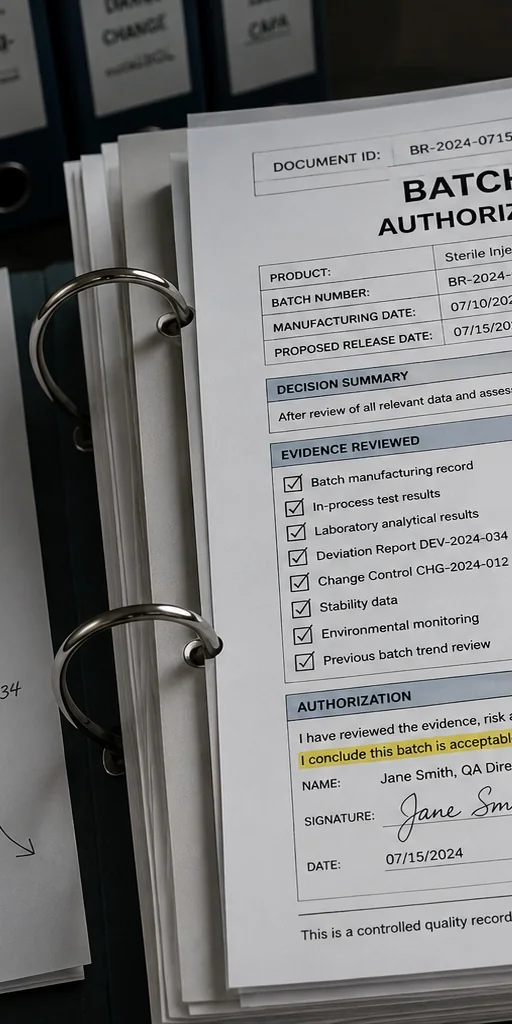
Where the review identifies a consequential exception, judgment, or accepted residual risk, the Batch Release Authorization Record can then preserve the evidence, judgment, risk evaluation, rationale, and accountable authorization behind the final decision.
Conclusion
A traditional batch-release workflow can produce compliant outcomes. But when the reasoning behind a consequential decision is distributed, it may be difficult to retrieve, connect, and explain under scrutiny.
A defensible decision is not only about having records. It is about having a complete, connected, and retrievable decision record that explains the evidence, judgment, risk, and authorization at the time the decision was made.
Testing one recently completed decision — and preserving it as a single completed record — is a practical way to reduce inspection risk, improve operational resilience, and strengthen executive confidence in high-consequence decisions.
Next step
Notes, sources and citations
-
U.S. FDA. Data Integrity and Compliance With Drug CGMP: Questions and Answers. Guidance for Industry. December 2018.
Open the source ↗ Link checked 2026-10-30
-
PIC/S. PI 041-1. Good Practices for Data Management and Integrity in Regulated GMP/GDP Environments. 1 July 2021.
Open the source ↗ Link checked 2026-10-30
-
U.S. FDA. Quality Systems Approach to Pharmaceutical CGMP Regulations. Guidance for Industry. September 2006.
Open the source ↗ Link checked 2026-10-30
Corrections and version history
Current version 1.0, effective November 1, 2026. No corrections have been issued.
- v1.0 · Publication. First published in Issue 03.
We correct factual errors in the text and date every change. Material changes are listed here; the web version is the version of record.