Flagship research
AI at Work in Life Sciences
When employees use AI in consequential work, can the organization show how it affected the decision?
Executive summary
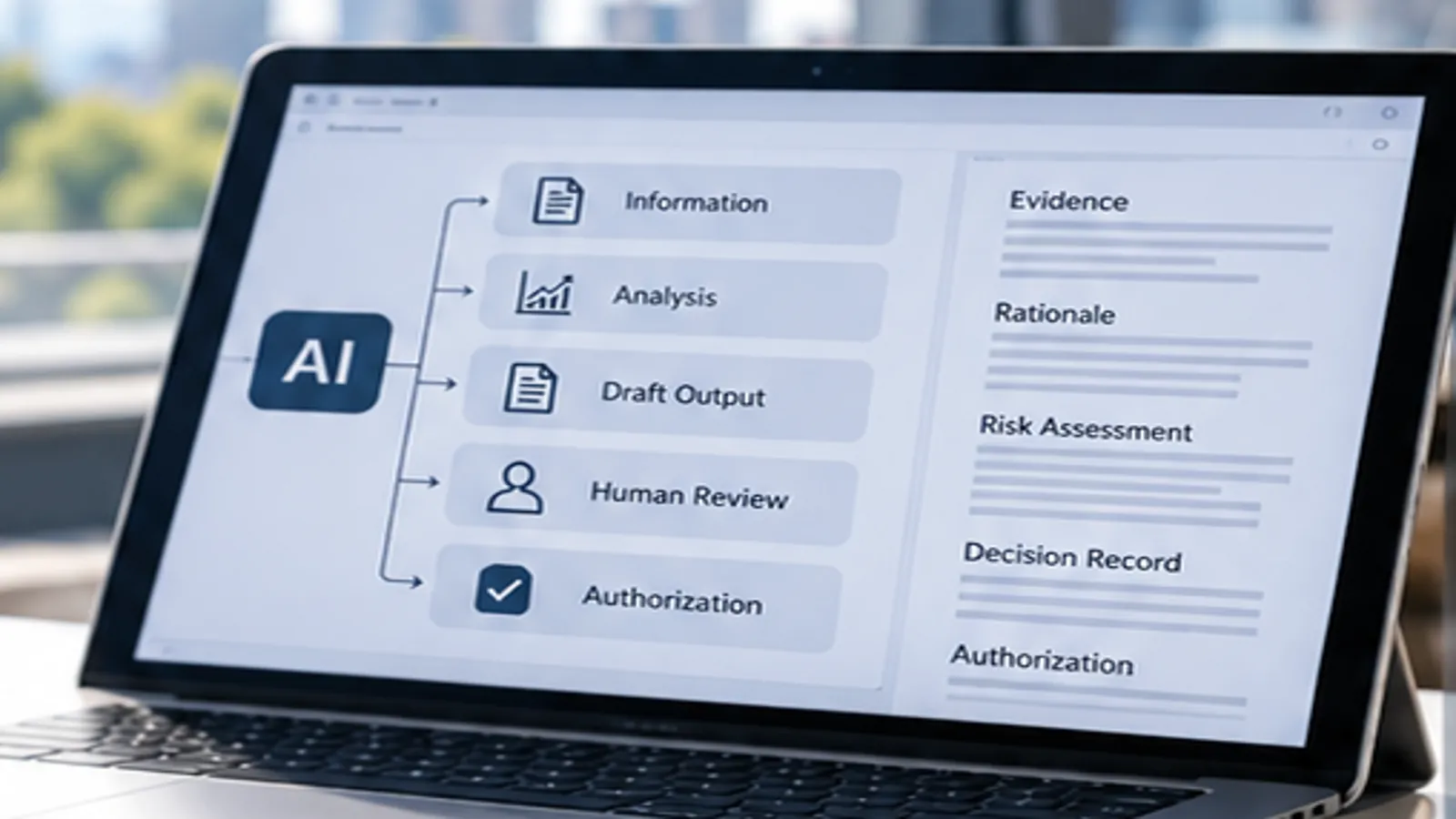
A quality specialist uses an approved AI assistant to summarize evidence for an investigation. A manufacturing team receives an AI-generated warning about a developing process trend. A regulatory writer uses AI to assemble a first draft from prior submissions. A clinical team uses a model to help identify relevant evidence and prepare a protocol.
Each use may be appropriate. Each may save time or reveal something a person might otherwise miss. But if the output materially affects a regulated record or consequential decision, an accountable executive needs answers to a different set of questions:
- What information did the system use?
- What did it produce or recommend?
- What did the employee verify?
- What changed between the AI output and the final decision?
- What uncertainty or risk remained?
- Who authorized the result?
AI is already entering ordinary work across life-sciences companies. The management issue is no longer simply whether employees will use it. It is whether the organization can see where AI enters controlled work and produce a reliable record of how it influenced the outcome.
The adoption evidence makes that issue urgent. KPMG reported that 48% of life-sciences organizations were strategically integrating AI into core functions and 87% were integrating AI agents into some workflows, products, or services. Deloitte found that only 22% of life-sciences leaders said they had successfully scaled AI and just 9% reported significant returns. ZS found that roughly one-third of employees in each surveyed life-sciences department had approved access to generative-AI tools, but respondents estimated that only about 10% of employees with access used them consistently each week.[1][2][3]
These findings describe an industry in transition. AI presence is high. Access is expanding. Repeated workflow use and measurable value are less mature. The companies moving furthest are not merely buying copilots. They are placing AI inside established workflows, connecting it to approved information, training employees by role, and defining where human review and authorization remain mandatory.[4][5][6]
Yet policies, training, and model controls do not by themselves show what happened in a particular decision. An organization may have an approved platform and still be unable to demonstrate which evidence was considered, how the employee evaluated the output, or why the final action was authorized.
This report is written for executives accountable for quality, regulatory compliance, and other controlled life-sciences functions. It examines what employees are doing with AI, where routine assistance becomes consequential, why “human reviewed” is an insufficient control description, and what evidence leadership should expect when AI contributes materially to a decision.
Its central conclusion is straightforward:
AI is already inside the work
Much of the public discussion about life-sciences AI focuses on drug discovery, model performance, technology partnerships, and long-term transformation. Those developments matter, but they can obscure a more immediate change: employees are beginning to use AI in the work that surrounds everyday decisions.
They use it to find information, summarize documents, compare records, draft content, identify patterns, classify cases, predict outcomes, and recommend actions. The tools may appear as secure chat assistants, specialized copilots, embedded analytics, workflow agents, or features inside systems employees already use.
Large companies provide visible examples. Moderna introduced an internal generative-AI assistant and later expanded access through ChatGPT Enterprise. Sanofi reports that 20,000 employees use its Plai data and decision-support platform every day. Roche developed both a general assistant and domain-specific tools, reportedly reaching approximately 12,000 daily users for RocheChat and more than 5,000 employees for LUMIN.[4][7][8][9]
Companies are also investing in workforce fluency. AstraZeneca made AI learning pathways available in 12 languages and reported more than 12,000 employees participating in tiered certifications by April 2025. Pfizer established an enterprise AI learning program and AI Academy intended to build fluency across employee levels. Sanofi reported broad participation in approved generative-AI learning.[5][6][10][11]
These examples show the direction of travel, not the experience of every company. Many midsize organizations will not build their own enterprise platforms or employ large central AI teams. They will encounter AI through software vendors, Microsoft 365, quality and regulatory systems, clinical platforms, analytics tools, customer systems, and employee experimentation.
That may make the management problem harder to see. AI is not necessarily introduced through one formal enterprise program. It can enter through multiple systems, functions, vendors, and employee practices before leadership has a complete view of where it is being used.
Exhibit 1: Access is not adoption
AI adoption should be understood as a progression rather than a yes-or-no condition:
- Experimentationselected employees test use cases or models.
- Approved accessthe company provides a secure assistant or enables AI features in existing software.
- Repeated useemployees rely on AI for recurring tasks rather than occasional exploration.
- Workflow integrationAI is connected to approved data, systems, handoffs, and review requirements.
- Scaled valuethe organization can demonstrate better quality, cycle time, capacity, cost, or outcomes without weakening control.
The distinction matters. A license count shows availability. A weekly-user count shows behavior. A completed workflow shows operational adoption. A verified outcome shows value. These measures should not be treated as interchangeable.
The current evidence suggests that access is moving faster than deep integration. KPMG found substantial agent activity alongside limited enterprise maturity in supporting and scaling AI. ZS found a marked difference between approved access and consistent weekly use. Deloitte’s scaling and return figures show that broad activity has not yet translated into enterprise results for most organizations.[1][2][3]
For an accountable quality or regulatory executive, the critical question is not where the company sits on an industry maturity curve. It is where AI is already affecting controlled work inside the organization—and whether those uses are visible.
What employees are doing
Although the systems differ, employee uses generally fall into seven task patterns:
- Finding: retrieving documents, prior decisions, scientific evidence, requirements, or internal knowledge.
- Summarizing: condensing studies, records, meetings, cases, trends, or investigations.
- Drafting: producing initial language for reports, protocols, submissions, responses, presentations, or communications.
- Comparing: identifying differences among records, versions, batches, studies, requirements, or outcomes.
- Classifying: sorting cases, deviations, documents, risks, signals, or requests.
- Predicting: estimating properties, outcomes, failures, demand, maintenance needs, or process behavior.
- Recommending or acting: proposing a next step—or, increasingly, executing one within delegated system permissions.
These tasks occur across functions, but their consequences are not equal.
Exhibit 2: From routine assistance to consequential use
| Employee use | Typical example | Consequence increases when the output… |
|---|---|---|
| Find | Retrieve relevant procedures or prior records | Determines what evidence is included or excluded |
| Summarize | Condense an investigation, study, or signal | Becomes the basis for an assessment or approval |
| Draft | Prepare a report, protocol, submission, or response | Enters a regulated record or external communication |
| Compare | Identify discrepancies or trends | Drives escalation, disposition, or corrective action |
| Classify | Categorize a case, deviation, document, or risk | Affects reporting, prioritization, or compliance treatment |
| Predict | Estimate failure, quality, demand, or outcome | Influences product, patient, trial, or supply decisions |
| Recommend or act | Propose or execute a next step | Changes a controlled process or commits the organization |
A useful governance question is therefore not simply, “Which functions use AI?” It is, “At what point does an AI-assisted task begin to influence a consequential decision?”
Where assistance becomes consequential

Consider a composite example.
A quality team is investigating an unexpected manufacturing result. An approved AI tool retrieves prior deviations, extracts potentially relevant process data, summarizes operator notes, and drafts a preliminary assessment. The investigator reviews the draft, checks selected sources, adds operational context, and recommends that no broader corrective action is required. A quality leader approves the investigation.
The final conclusion may be sound. But an independent reviewer would still need to understand:
Which prior deviations and records the system retrieved.
Whether relevant information was omitted.
How the system linked the evidence to its draft conclusion.
Which sources the investigator actually verified.
What the investigator changed or rejected.
Why the remaining uncertainty was acceptable.
Who had authority to approve the final disposition.
The consequential moment is not necessarily when the employee opens the AI tool. It is when the output begins to shape what evidence is considered, what conclusion is reached, or what action is authorized.
That moment can occur even when AI never makes the final decision. A summary can narrow attention. A classification can determine priority. A recommendation can anchor judgment. A draft can become the structure that reviewers refine rather than reconsider.
This is why a policy statement that “AI does not make decisions” may offer less protection than it appears to. AI can materially influence a decision without holding formal decision authority.
A proportional control model
Not every use needs the same evidence. An employee who uses an approved assistant to improve the wording of an internal meeting invitation does not need a formal decision record. An AI-generated draft supporting a batch disposition, safety assessment, regulatory response, or clinical decision requires substantially more control.
The required evidence should rise with:
The consequence of an incorrect or incomplete output.
The degree to which the employee relies on it.
The difficulty of detecting an error.
The authority delegated to the system.
The reversibility of the resulting action.
The effect on patients, product quality, regulatory evidence, or external claims.
Exhibit 3: Consequence and control
Low-consequence assistance
- Examples
- rewriting internal text, summarizing a nonauthoritative meeting, generating presentation ideas.
- Expected control
- approved tool, appropriate data handling, employee verification.
Controlled workflow support
- Examples
- searching approved procedures, preparing a report draft, comparing controlled records, identifying potential trends.
- Expected control
- defined use, authoritative sources, trained reviewer, traceable corrections, workflow ownership.
Consequential decision support
- Examples
- supporting a quality disposition, safety assessment, clinical conclusion, regulatory response, manufacturing intervention, or external medical claim.
- Expected control
- clear context of use, validated or justified performance, material input and output evidence, meaningful expert review, documented judgment, risk treatment, authorization, and outcome monitoring.
Delegated or agentic action
- Examples
- updating controlled systems, initiating communications, changing workflow status, or executing a sequence of actions.
- Expected control
- constrained permissions, identity, approved action boundaries, interruption and escalation mechanisms, complete logging, monitoring, and accountable human ownership.
FDA’s 2025 draft guidance proposes a risk-based credibility framework for AI outputs used to support regulatory decision-making, centered on the model’s context of use. FDA’s later good-AI-practice principles emphasize human-centric design, clear context of use, multidisciplinary expertise, data governance, documentation, performance assessment, and life-cycle management. These principles concern regulatory decision support, but the underlying logic is useful more broadly: evidence and control should match the intended use and risk.[12][13]
Why “human reviewed” is not enough
“Human in the loop” has become a shorthand assurance that AI remains under control. It does not describe what the person actually did.
In the investigation example, the quality specialist may have read the generated assessment and clicked approve. Or the specialist may have traced every material assertion to source data, identified an omitted deviation, corrected a false causal inference, considered an alternative explanation, documented the remaining uncertainty, and changed the proposed action.
Both workflows can be labeled “human reviewed.” They are not equivalent.
Meaningful human oversight requires more than presence. The reviewer must:
Have relevant domain competence.
Understand the intended use and material limitations.
Have access to the underlying evidence.
Know which elements require verification.
Have sufficient time to perform a real review.
Be able to change, reject, or escalate the output.
Understand the consequences of acceptance.
Remain accountable for the resulting judgment.
A human click at the end of an opaque automated process does not establish effective oversight.
This matters because fluent AI output can create an illusion of completeness. Reviewers may focus on whether the language sounds reasonable rather than whether the evidence set was complete, the reasoning was appropriate, or contradictory information was excluded.
Organizations should therefore define the human role more precisely. Is the person an editor, source verifier, investigator, decision owner, approver, monitor, or exception handler? What is the person expected to check? What authority does that person retain? What evidence shows that the review occurred?
Training also needs to reflect that role. General AI literacy can help employees use approved tools safely. It cannot replace the function-specific competence needed to review an AI-supported quality, regulatory, safety, clinical, or manufacturing result.
The record leadership should expect
Policies answer what is generally permitted. Validation and model governance answer whether a system is suitable for a defined use. A decision record answers what happened in a particular instance.
For consequential AI-supported work, leadership should expect a record that allows an independent reviewer to follow the material chain from purpose to outcome.
Exhibit 4: The AI-supported work record
This worksheet organizes your notes. It does not make, approve, or recommend a regulated decision. The regulated organization and its authorized personnel remain accountable.
This does not mean retaining every prompt for every use. Nor does it mean surrounding routine work with unnecessary paperwork. It means preserving the material evidence needed to understand an important decision when AI influenced the evidence, analysis, recommendation, or action.
The exact record will vary by context. Some information may already exist in audit trails, source systems, validation packages, controlled records, review histories, or approval workflows. The management task is to determine whether those elements collectively show how the decision was made—or whether the organization would have to reconstruct the story later from system logs and employee memory.
Return to the quality investigation. A complete record would not merely contain the final approved assessment. It would allow a reviewer to identify the sources assembled by the AI, the material draft or recommendation, the employee’s substantive review, the reasoning behind the final disposition, the uncertainty accepted, and the authorization.
If those elements are scattered across systems, transient chat sessions, undocumented corrections, and personal recollection, formal approval may exist without meaningful decision visibility.
Conclusion
AI adoption in life sciences is no longer a distant transformation program. It is becoming part of ordinary work.
Employees are using AI to find information, summarize records, draft content, compare evidence, classify cases, predict outcomes, and recommend actions. Companies are providing secure assistants, embedding AI inside established systems, and training employees to use it. At the same time, repeated use, workflow integration, and measurable enterprise value remain uneven.[1][2][3]
For accountable executives, the central risk is not simply that an AI system might be wrong. It is that AI can influence a consequential decision without leaving a record that shows how the influence occurred.
An approved tool is not proof of an appropriate use. A trained employee is not proof of an adequate review. A human approval is not proof of meaningful judgment. A final record is not complete if the organization cannot show the material evidence, output, review, reasoning, risk, and authorization behind it.
The next phase of AI adoption will require more than access and policy. It will require an operating discipline that preserves human accountability as work becomes faster, more automated, and more difficult to reconstruct.
The immediate leadership action is deliberately narrow:
If the organization cannot answer those questions from the record, it has identified the first control gap to address before AI moves deeper into the work.
Notes, sources and citations
-
KPMG Global tech report 2026: Life Sciences
Open the source ↗ Link checked 2026-10-30
-
2025 AI trends: Life sciences leaders on data, digital and AI
our respondents estimate that only around 10% of employees with access to company-approved gen AI to...
Open the source ↗ Link checked 2026-10-30
-
2026 Life sciences outlook | Deloitte Insights
Life sciences leaders are generally optimistic for 2026, but see resilience and adaptability as esse...
Open the source ↗ Link checked 2026-10-30
-
Digital Transformation and Artificial Intelligence
20,000 Sanofians use plai every day—our industry-leading app that delivers real-time, reactive data ...
Open the source ↗ Link checked 2026-10-30
-
Upskilling our workforce to thrive in the age of AI
Our digital and AI learning pathways are available to all AstraZeneca employees and are available in...
Open the source ↗ Link checked 2026-10-30
-
Building an AI-Fluent Organization
Resources are available through Pfizer AI Academy, a curated learning platform offering training and...
Open the source ↗ Link checked 2026-10-30
-
Our Journey to Becoming a Real-Time AI Organization
We developed mChat, Moderna's own generative AI product, modeling tools to automate tasks across dep...
Open the source ↗ Link checked 2026-10-30
-
Collaboration with OpenAI: Transforming the Way We Work ...
Open the source ↗ Link checked 2026-10-30
-
How Roche executed a scalable and secure AI strategy
Roche built 2 AI apps with OutSystems in 3 months: a daily task companion (12K users) and a domain-s...
Open the source ↗ Link checked 2026-10-30
-
2024 Document enregistrement universel
Open the source ↗ Link checked 2026-10-30
-
2025 Impact Report
we are investing in our colleagues by offering an enterprise-wide AI learning program to strengthen ...
Open the source ↗ Link checked 2026-10-30
-
Considerations for the Use of Artificial Intelligence
this guidance provides a risk-based credibility assessment framework that may be used for establishi...
Open the source ↗ Link checked 2026-10-30
-
Guiding Principles of Good AI Practice in Drug Development
Clear context of use; Multidisciplinary expertise; Data governance and documentation; Model design a...
Open the source ↗ Link checked 2026-10-30
Evidence map: where each source is used
- “The adoption evidence makes that issue urgent. KPMG reported that 48% of life-sciences organizations were strategically integrating AI into core functions and 87% were…” Sources: [1] [2] [3]
- “These findings describe an industry in transition. AI presence is high. Access is expanding. Repeated workflow use and measurable value are less mature. The companies…” Sources: [4] [5] [6]
- “Large companies provide visible examples. Moderna introduced an internal generative-AI assistant and later expanded access through ChatGPT Enterprise. Sanofi reports…” Sources: [4] [7] [8] [9]
- “Companies are also investing in workforce fluency. AstraZeneca made AI learning pathways available in 12 languages and reported more than 12,000 employees participating…” Sources: [5] [6] [10] [11]
- “The current evidence suggests that access is moving faster than deep integration. KPMG found substantial agent activity alongside limited enterprise maturity in…” Sources: [1] [2] [3]
- “FDA’s 2025 draft guidance proposes a risk-based credibility framework for AI outputs used to support regulatory decision-making, centered on the model’s context of use.…” Sources: [12] [13]
- “Employees are using AI to find information, summarize records, draft content, compare evidence, classify cases, predict outcomes, and recommend actions. Companies are…” Sources: [1] [2] [3]
Corrections and version history
Current version 1.0, effective November 1, 2026. No corrections have been issued.
- v1.0 · Publication. First published in Issue 03.
We correct factual errors in the text and date every change. Material changes are listed here; the web version is the version of record.