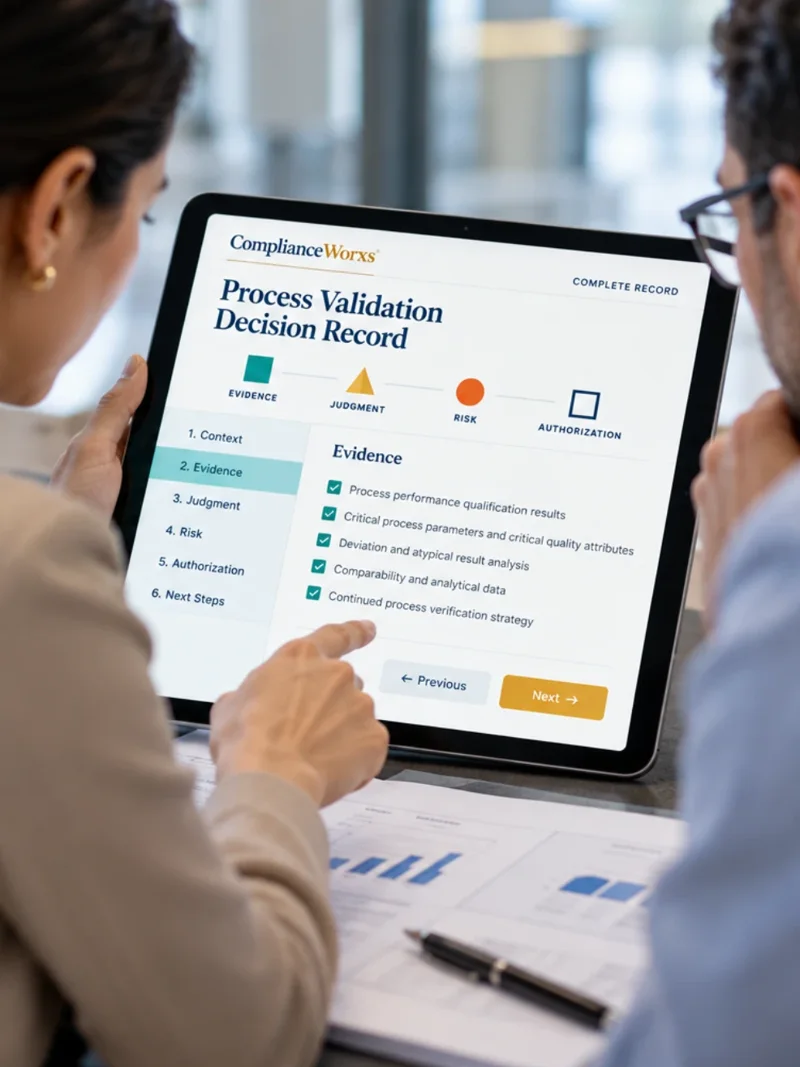
The process was approved.Was its performance demonstrated?
A signed validation report shows that a protocol was run. The Case File shows what the decision needs to preserve: what the data showed, how unexplained variability was weighed, the risk accepted, and who authorized the process for commercial use before it began.
When the inspector asks what showed this process performs and who decided it could be used, this is the record that answers.
A PPQ passed on paper, but one batch or trend does not sit right and you must decide whether the process is qualified.
Who it is for: Heads of Quality who decide whether a process is qualified, and the validation leads who write the conclusion.
What you get
$149 One completed, clearly labeled fictional worked record showing the evidence, judgment, remaining risk and authorization behind the decision. Delivered after payment. It does not assess your own decision.
Your $149 applies toward the $497 Inspection Response Record if you later preserve a real decision.
Illustrative case. This is an excerpt of the worked record inside the Case File: PPQ protocol PV-2025-0117 for an immediate-release 250 mg tablet, where every result met specification but the hardness capability criterion in PPQ batch 2 was not met. The company, product, people, dates, identifiers, results, cost figures and events are fictional. This is not an FDA observation or a Form 483. In the scenario the firm concluded the process was validated without this record. The excerpt shows the record that should have existed before commercial use.
DecisionDo not conclude the process is qualified; investigate, extend the PPQ, and define monitoring first
Authorized9 September 2025, 16:20 EDT, before the PPQ report was approved
What was checked, and against which records
Protocol criteria compared. Hardness: every result within specification and a Ppk of at least 1.33 in each PPQ batch.
Hardness capability. Ppk 1.52, 1.04 and 1.47 across batches 1 to 3. Batch 2 does not meet the criterion.
In-process data. A downward hardness trend in the middle of the batch 2 compression run, then a return to the batch 1 level.
Other attributes. Assay, content uniformity and dissolution within specification in all three batches.
Deviation log. No deviation opened for the trend; the cause is unconfirmed.
The conclusion, and what was rejected
Qualification conclusion held. The criterion was not met in one of three batches, the cause is unconfirmed, and three batches give limited information about between-batch variability. Commercial use is not authorized.
Conclude validated because every result met specification. Rejected: the protocol set a capability criterion and no rationale explained why the conclusion still held.
Treat batch 2 as isolated and rely on batch 3. Rejected: with no confirmed cause, one recovery batch does not show the drift cannot recur.
This is the scenario’s conclusion, not a rule for every PPQ. Batch numbers and criteria are product- and process-specific.
What must happen before it can proceed
Technical. Investigate the batch 2 hardness trend and establish a cause, or record the limit of what can be known.
Statistical. Execute added PPQ batches under an amended protocol with a justified sampling plan and capability criteria.
Quality. Open and close the deviation, approve revised procedures, and hold the PPQ lots pending assessment.
Monitoring. Approve a continued process verification plan with defined signals, owners and escalation.
Who authorized the decision
Dana Whitfield, Vice President, Quality (illustrative), who held the qualification conclusion and authorized the investigation and added batches.
System action. A hold was applied to the PPQ lots, the commercial batch record release and the report approval task.
The record shows who held the authority, what they relied on, and when they decided, before commercial use. No one reconstructs it after the lots ship.
What the full Case File adds
The whole record, not one page of it.
One completed decision record with the evidence, the judgment, the risk, the authority, and the preventive controls, as a PDF delivered after payment.
Validation needs a qualification decision and a control-strategy decision. A passing PPQ settles neither.
A signed validation report has
A protocol
Three PPQ batches
Results within specification
A QA approval
Records an output. Not the basis for it.
→
An authorization record preserves
The result against each criterion
How variability was weighed
The rationale for the conclusion
The monitoring the process needs
The accountable owner
The conditions before commercial use
The basis, in a form an inspector can read.
Decision 1
Qualification (Stage 2)
CriteriaWas every acceptance criterion met, or evaluated and justified?
VariabilityWere atypical results and trends investigated?
EvidenceDo the data show the process is capable and controlled?
RationaleIs the scientific reasoning written down?
OwnerThe scientific and quality conclusion
Decision 2
Control strategy (Stage 3)
MonitorWhich parameters and attributes are watched after approval?
SignalsWhat statistical signal triggers action?
ResidualWhat does the remaining variability mean for the plan?
EscalationWho owns the response, and by when?
OwnerThe monitoring program and its escalation
Qualification decision recorded+Monitoring plan recorded→Commercial use released
The release rule. Release on the recorded decisions, not on a signed report. A successful PPQ is not permanent control. Could the system prove, without reconstruction, why this process was judged capable on that date?
Every result is within specification, but the record does not show the protocol’s own capability criteria were evaluated.
Variability not investigated
An atypical result or trend appears during the PPQ, but the record shows no deviation, no investigation and no cause.
Rationale not written
The report says “validated,” but the record does not show the scientific reasoning that connects the evidence to the conclusion.
Owner and monitoring not shown
The record carries a QA stamp, but not the named person who concluded the process was qualified, when they did so, or what will be monitored afterwards.
Your answers, and where the Case File answers them
Inside the $149 Case File
The process was approved. Now explain the conclusion.
See how one worked example connects the evidence, the reasoning, and accountable approval before commercial use.
The setup · illustrative case
An investigator selects a validation report after commercial lots were distributed, and asks what showed the process performs, how a hardness result that missed the protocol’s own criterion was weighed, and who authorized commercial use. The record held a “validated” conclusion and a QA approval, and nothing behind either. In this scenario that means extra PPQ batches, a review of 14 commercial lots, and a response cost above $1.9 million (an assumption of the case, not a verified figure). Here is what the record would have said.
In the inspector’s chair
The inspector asks
“What did the PPQ data show against your own acceptance criteria?”
From the record’s Evidence Reviewed
Hardness capability: Ppk 1.52, 1.04 and 1.47 for batches 1, 2 and 3. The batch 2 value does not meet the protocol criterion of 1.33.
In-process data: a downward hardness trend in the middle of the batch 2 run, then a return to the batch 1 level. No deviation was opened and the cause is unconfirmed.
Assay, content uniformity and dissolution were within specification in all three batches.
Why it matters. It separates what the data established from what was only inferred, and it shows the unmet criterion before the process is used.
The inspector asks
“How did you weigh the batch 2 result, and what supported the conclusion?”
From the record’s Judgment
Every result met specification, so the conclusion could not rest on specification alone. The protocol set a capability criterion, it was not met in one of three batches, and the cause is unconfirmed.
Under the facts assumed in this case, one recovery batch does not show the drift cannot recur. The process is not concluded to be qualified.
Why it matters. The conclusion is tied to the protocol and the evidence, and it states the assumptions it depends on.
The inspector asks
“Who authorized the conclusion, and under what condition?”
From the record’s Authorization
Based on the evidence and assumptions listed, I do not conclude that the process is qualified. Commercial use is not authorized, and the PPQ lots are held. I authorize the investigation, a protocol amendment and added PPQ batches, and require a continued process verification plan before the conclusion is reconsidered.
Dana Whitfield · Vice President, Quality (illustrative) 9 September 2025 · 16:20 EDT · before the PPQ report was approved
Why it matters. A name, a title, a timestamp that precedes commercial use, and a condition the system enforces. A QA approval shows the report was signed; this is the authorization.
1 of 3
Get the Case File
Start with the finished validation record.
The Case File is a worked example for leaders and review teams. It does not document your own validation conclusions.
ComplianceWorxs AssistantCase Files · DDA · IRR English · Español · हिन्दी · 中文
Language
Ask which decision type, Case File, DDA, or IRR fits what you are working on. This is not regulatory or legal guidance. You are chatting with an assistant, not a person. Do not enter confidential records, proprietary decision facts, or sensitive documents.
I can point you to the right decision type, Case File, DDA, or IRR. I do not give regulatory or compliance advice. I am an assistant, not a person.