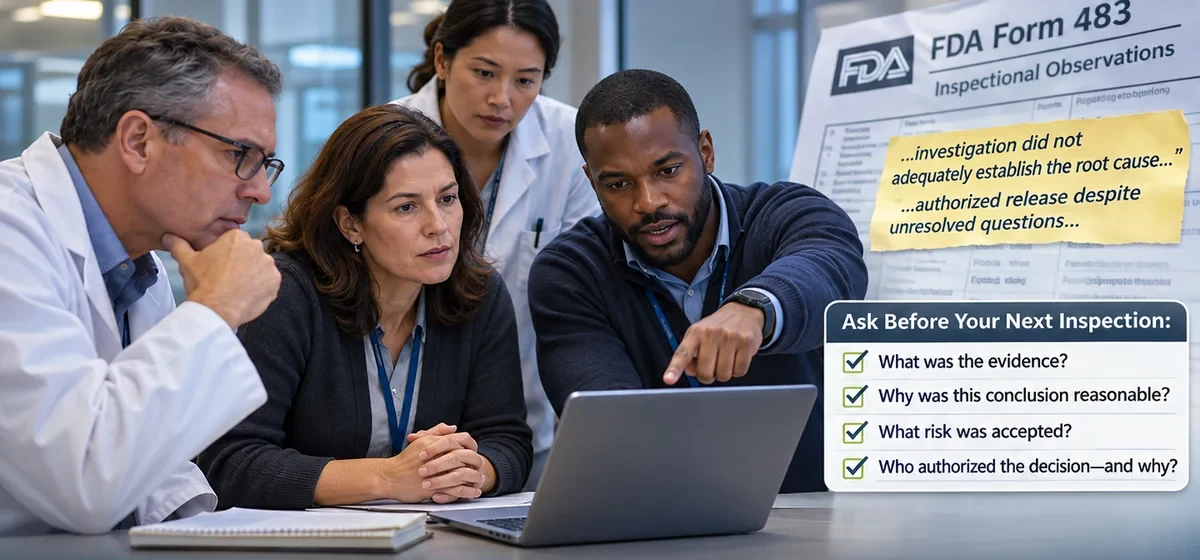
Two experienced Quality professionals examine the same evidence and reach different conclusions. When the stakes are high, what justifies either decision?
In this article
The decision everyone thought was settled
The investigation has been open for three weeks.
Your team has reviewed the laboratory results, examined manufacturing records, interviewed personnel, and evaluated possible causes.
The investigation lead believes the evidence supports closure. The most likely cause has been identified, the corrective actions appear reasonable, and no additional product impact has been established.
But another experienced Quality professional disagrees.
She isn’t convinced the evidence supports the proposed root cause. An alternative explanation hasn’t been adequately excluded. She believes the investigation needs to go further before the conclusion can be accepted.
Both professionals understand the regulations. Both have years of experience. Both believe they’re protecting product quality. And both are looking at essentially the same information.
Who is right? More importantly, how does the organization decide?
This is one of the most consequential challenges in pharmaceutical Quality management. Regulations establish requirements, but they cannot prescribe the correct judgment for every investigation, deviation, CAPA, or batch-disposition decision.
Knowing those requirements does not eliminate uncertainty about how to apply them. Experience, technical expertise, assumptions, and perceptions of risk can lead qualified professionals to interpret the same evidence differently.
The organizational challenge is to understand those differences, evaluate their significance, and establish what evidence justifies proceeding.
What FDA findings reveal about judgment
FDA Form 483 observations document conditions that, in an investigator’s judgment, may constitute violations of applicable requirements. They are not final agency determinations of noncompliance.
Published FDA warning letters offer another window into the quality decisions organizations make and the evidence used to support them. FDA publishes them on FDA.gov, with the facility named and the findings public.
The findings frequently involve incomplete investigations, inadequate root-cause evaluations, insufficient corrective actions, and failures to assess potentially affected products.
But behind these deficiencies lies a question that deserves attention from every Quality leader:
What led the organization to conclude that its available evidence was sufficient to justify its actions?
Two FDA warning letters illustrate different aspects of that problem.
When a passing result becomes the basis for a decision
Apotex Inc. — FDA warning letter, October 31, 2025
During an inspection of an Apotex manufacturing facility in Canada, FDA identified deficiencies involving investigations of critical equipment failures and container-closure integrity issues.
According to the warning letter, the company failed to adequately investigate at least eight failures during leak testing between September 2023 and April 2025.
FDA reported that production personnel repeatedly performed leak testing until passing results were obtained rather than investigating the root cause of the failures.
The letter also described production personnel filling products on the equipment for more than a year without adequately addressing uncertainty about its integrity. Separately, FDA cited the company for not evaluating root causes or assessing the impact on other potentially affected batches.
Read the FDA warning letter — Apotex Inc., October 31, 2025
Where the consequential judgment occurs
Consider the decision problem in a simpler hypothetical situation.
A critical piece of equipment fails an integrity test. The test is repeated, and the equipment passes.
Production is waiting. The equipment has previously performed acceptably. The team believes the initial failure may have resulted from a testing anomaly.
One professional argues that the subsequent passing result supports continued operation. Another argues that the original failure remains unexplained.
Both recognize the importance of equipment integrity. Their disagreement concerns what the available evidence actually demonstrates.
Three questions become decisive:
- Does the passing result explain the original failure?
- Does it establish reliable equipment performance?
- What does it establish about potentially affected production?
The answers determine whether the evidence supports continued operation or whether additional investigation and action are necessary.
The important distinction is between what the test demonstrates and what the organization concludes from it.
A subsequent passing result is relevant evidence. It does not automatically resolve the uncertainty created by an earlier failure.
FDA’s documented concerns in the Apotex case involved inadequate investigations, unresolved questions about equipment integrity, and the assessment of other potentially affected batches. The hypothetical above illustrates one decision challenge; it does not represent the full circumstances or findings of that inspection.
For other manufacturers, the lesson is to recognize when technical evidence becomes the basis for a consequential Quality decision—and ensure the resulting inference is justified.
When a plausible explanation becomes an accepted root cause
Tower Laboratories Ltd. — FDA warning letter, December 23, 2025
FDA identified deficiencies in Tower Laboratories’ investigations of out-of-specification laboratory results involving over-the-counter pharmaceutical products.
The warning letter described tablet lots that failed assay testing at the nine-month stability timepoint. A retest using additional samples also produced failing results.
FDA reported that the laboratory investigations did not include sufficient detail and lacked root causes for the failures.
In its response, the company described the results as representative of microscopic packaging defects noted in a previous investigation.
FDA found that the investigation lacked sufficient rigor to show how the proposed packaging defects led to a failure in product quality.
FDA described the finding as a repeat observation from its 2021 inspection, when the company had also attributed assay failures to packaging defects.
Read the FDA warning letter — Tower Laboratories Ltd., December 23, 2025
The difference between a possible cause and a supported conclusion
This example illustrates a distinction investigators encounter regularly.
An explanation can be plausible without being adequately demonstrated.
A packaging defect might reasonably be investigated as a possible explanation for a stability failure. But identifying a possible mechanism is not the same as establishing that it caused the observed result.
Three questions help expose the difference:
- What evidence connects the proposed defect to the assay failure?
- Were other scientifically plausible explanations evaluated?
- What remains uncertain about the quality of the affected product?
The challenge becomes particularly important when an investigation team develops confidence in a preferred explanation.
As the investigation progresses, a working hypothesis can gradually become the accepted conclusion. Subsequent evidence may be interpreted through that hypothesis, while conflicting information receives less attention.
By final approval, the conclusion can appear more certain than the underlying evidence supports.
That does not mean a definitive root cause can always be established. It means the investigation must accurately distinguish what has been demonstrated, what remains uncertain, and what action the evidence and applicable requirements justify.
Practice the judgment
Reviewing an investigation means deciding whether the evidence supports the proposed conclusion—not simply whether the report is complete.
The purpose is not to memorize an expected answer. It is to distinguish facts from assumptions, recognize material uncertainty, and identify what additional evidence could change your judgment.
If an inspector pulled your last three OOS dispositions tomorrow, could you show, for each one, the evidence relied on, the alternatives rejected, and who authorized proceeding?
A realistic OOS scenario offers a way to practice those decisions without the pressure of an active manufacturing event.
Why professional judgment varies
Differences in scientific judgment are not necessarily evidence of poor performance. Qualified professionals may reasonably disagree about the significance of an observation, the strength of a causal explanation, or the likelihood of potential harm.
But those differences can also arise from unexamined assumptions, incomplete information, cognitive bias, or inconsistent approaches to risk evaluation.
ICH Q9(R1), Quality Risk Management, explicitly addresses subjectivity in quality-risk assessments and decision-making. The guidance recognizes that subjectivity can arise from differences in risk perception, bias, poorly defined risk questions, and poorly designed risk scoring scales.
It recommends managing subjectivity through appropriate use of relevant data, scientific knowledge, risk-management methods, and examination of assumptions.
Consistency does not mean forcing every professional to reach an identical conclusion. It means using a disciplined, transparent process to evaluate differences, determine what additional evidence or action is necessary, and establish who is authorized to decide.
Approval is not the same as justification
An investigation can complete every required approval step and still contain an insufficiently supported conclusion.
Approval identifies who authorized the decision. It does not, by itself, establish the scientific basis for it.
Consider what happens when a new Quality manager reviews an investigation closed six months earlier.
The record contains the investigation chronology, test results, proposed root cause, corrective actions, and required approvals. But the manager questions whether the evidence supported the conclusion.
If the original reasoning was clearly documented, the manager can examine the competing interpretations and understand why the decision was authorized.
If the reasoning is missing, the organization may have to reconstruct it through undocumented discussions, personal recollection, or assumptions about what the original reviewers considered. Information gathered later may also be mistakenly treated as though it supported the decision at the time.
A signature establishes that a decision was approved. The evidence and reasoning establish whether it was justified.
Justification does not require every qualified professional to agree. It requires that the decision can be evaluated against the information available when it was made, the relevant scientific considerations, the uncertainty involved, and the applicable requirements.
That reasoning should remain understandable after the original decision-makers have moved on.
Four disciplines that strengthen decisions under uncertainty
Quality professionals cannot eliminate uncertainty from every consequential decision. They can, however, make its implications visible and establish a consistent basis for deciding how to proceed.
The four disciplines below offer a practical way to examine a decision.
1. Evidence: What do we actually know?
Distinguish documented facts from assumptions and interpretations.
Identify the relevant data, contradictory findings, and limitations affecting the evidence.
Consider what the evidence establishes—and what it does not.
2. Judgment: Why is this interpretation reasonable?
Explain how the organization moved from the evidence to its conclusion.
Which alternative explanations were considered? What supported or contradicted them? Why was the selected interpretation accepted?
The objective is not to manufacture certainty. It is to demonstrate scientifically disciplined reasoning.
3. Risk: What are the consequences of being wrong?
Evaluate the implications of remaining uncertainty.
Could the decision affect product quality, patient safety, other batches, or related manufacturing operations?
What controls are available? Does the uncertainty require additional investigation, containment, or other action?
Risk evaluation should inform the decision rather than rationalize a conclusion already reached. It cannot replace compliance with applicable GMP requirements.
4. Authorization: What justified proceeding?
Establish who accepted the conclusion and what information informed that authorization.
Was the relevant evidence available to the decision-maker? Were limitations and residual risks understood?
Was the authorized action consistent with applicable requirements and established responsibilities?
Together, these four disciplines connect evidence, judgment, risk, and authorization. They give another qualified professional a basis for evaluating how a decision was reached and whether it was justified.
They complement the principles of scientifically informed decision-making in ICH Q9(R1) and the investigation obligations in 21 CFR 211.192.
What Quality leaders should examine before their next inspection
Quality management commonly monitors investigation closure rates, overdue deviations, CAPA completion, and batch-release performance.
These indicators help organizations manage workload and operational performance. But they do not necessarily establish whether similar situations are being evaluated consistently or whether difficult conclusions are supported by adequate evidence.
When comparable decisions depend heavily on individual reviewers rather than a shared standard of reasoning, the consequences can include repeated disagreements, unnecessary rework, and unclear escalation thresholds.
A useful management exercise is to examine a small sample of previously approved decisions involving meaningful uncertainty.
An independent decision review
Select three consequential decisions:
- An OOS investigation with competing possible causes.
- A deviation involving potential product impact.
- A CAPA effectiveness determination based on limited monitoring data.
Ask a qualified professional who did not participate in the original decision to review each record using only the evidence available at the time.
Then examine five questions.
- What conclusion would the independent reviewer reach? The reviewer should assess the evidence without assuming that the original conclusion was correct.
- Where does that interpretation differ from the approved decision? Identify differences involving factual interpretation, assumptions, scientific reasoning, and risk assessment.
- What evidence could resolve the disagreement? Determine whether the difference arises from missing information, inadequate investigation, or a genuinely uncertain scientific question.
- Would the competing interpretations lead to different actions? Consider whether they would affect product disposition, corrective actions, investigation scope, or additional risk controls.
- Does the original record explain why the decision was justified? Examine the reasoning documented when authorization occurred, rather than explanations constructed afterward.
The exercise is not intended to penalize professionals for differences in judgment or reopen investigations indiscriminately. Its purpose is to evaluate whether the organization’s decisions are scientifically understandable, appropriately justified, and sufficiently consistent.
Where a review identifies a credible, previously unrecognized product-quality or compliance concern, the organization should address it through its established quality-system processes.
The exercise may reveal that existing decisions are well supported. It may also identify recurring weaknesses in how uncertainty is evaluated, alternative explanations are considered, or authorization is documented.
Either result provides useful management information.
Before the next inspection
The goal is not to make every qualified reviewer agree. It is to ensure that disagreement can be examined—and that the organization can explain why its chosen action was justified.
Procedures and approvals matter. So does the reasoning connecting the evidence to the decision, including the alternatives considered and the uncertainty that remained.
That reasoning should not depend on the original decision-makers being available to explain it.
The decision is documented. Is the reasoning?
Regulatory context and sources
FDA’s Form 483 FAQ states that the form does not constitute a final Agency determination of whether any condition is in violation of the FD&C Act or its regulations. 21 CFR 211.192 requires production and control records to be reviewed and approved by the quality control unit, and requires any unexplained discrepancy, and the failure of a batch or any of its components to meet its specifications, to be thoroughly investigated, with a written record of the conclusions and followup. FDA’s guidance Investigating Out-of-Specification (OOS) Test Results for Pharmaceutical Production describes the expected approach to OOS investigations.
Source context: FDA warning letters: Apotex Inc., October 31, 2025; Tower Laboratories Ltd., December 23, 2025. Regulatory and guidance references: FDA Form 483 Frequently Asked Questions; 21 CFR 211.192, Production record review; Investigating Out-of-Specification (OOS) Test Results for Pharmaceutical Production; ICH Q9(R1), Quality Risk Management. The opening workplace scenario and hypothetical decision examples are illustrative. The Apotex and Tower Laboratories sections summarize findings in the published FDA warning letters; the associated analysis is ComplianceWorxs’ interpretation, not additional FDA findings. The OOS Investigation Case File is a separate educational scenario and is not based on either manufacturer’s investigation. This article has not been reviewed by a practitioner for regulatory sufficiency. ComplianceWorxs does not provide regulatory or legal advice and does not judge whether any record or decision is adequate.