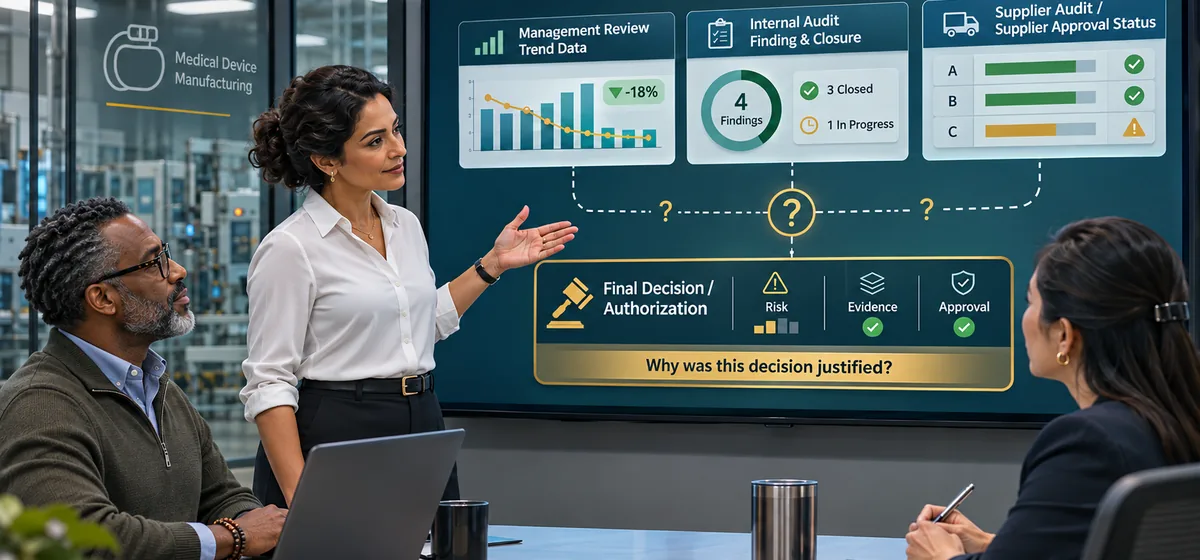
A management team recognizes a recurring quality problem and postpones corrective action. An internal audit finding is closed after procedures are revised. A supplier remains approved despite unresolved deficiencies.
In this article
Each decision may have a reasonable basis. But can someone outside the organization understand that basis from the records—without asking the people involved to reconstruct what happened?
For medical device manufacturers, that question has become more immediate.
What changed—and what did not
The FDA’s Quality Management System Regulation, effective February 2, 2026, removed the previous exemption from FDA inspection for management review, internal quality audit, and supplier audit reports. FDA confirms that investigators may now inspect those records. This is a medical-device regulatory change, not a new blanket rule covering every life-sciences company.
The change does not mean every management judgment has become a separate regulatory violation waiting to happen. It means records previously exempt from inspection can now reveal how an organization recognized quality problems, evaluated evidence, and decided what to do. FDA’s inspection program examines whether applicable requirements are met and risks are adequately controlled.
The distinction matters: a completed report establishes that an activity occurred. It may not establish why the resulting decision was justified.
The following three situations are illustrative, not accounts of actual FDA findings. The evidence questions are practical ways to examine a decision—not a claim that FDA requires a particular decision-record template.
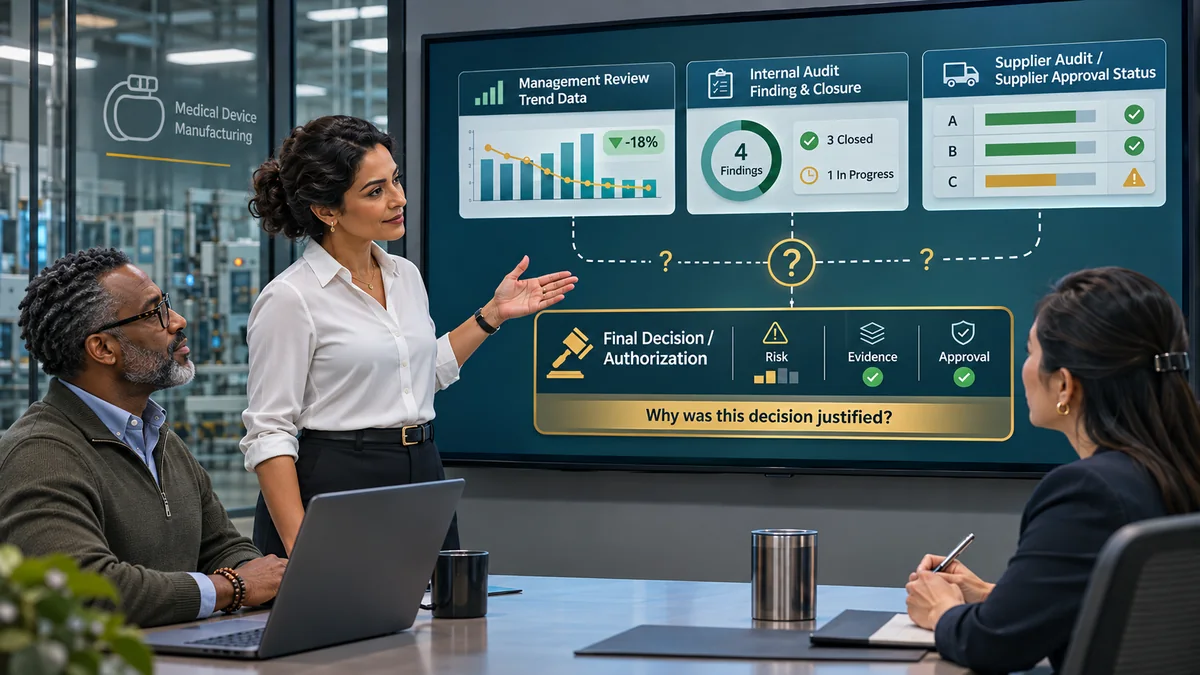
1. Management review: Leadership recognized a recurring trend but deferred corrective action
At a quarterly management review, leadership sees the same manufacturing deviation appearing across successive reporting periods. Quality recommends a broader investigation and corrective action. Operations proposes another monitoring period while an equipment upgrade is completed.
Leadership agrees to wait.
The minutes record: “Trend reviewed. Continue monitoring. Revisit next quarter.”
The decision weakness
The minutes show awareness and an outcome. They do not explain why waiting was acceptable.
Was recurrence increasing? Had the team assessed potential product impact? Were existing controls containing the problem? What would trigger action before the next quarterly meeting?
“Continue monitoring” can describe a controlled, time-limited decision. It can also conceal an unresolved problem without a meaningful intervention point. Here, the record does not establish which occurred.
The weakness is not necessarily the deferral itself. It is the absence of a documented basis for that deferral.
The evidence a reviewer would examine
To understand the decision, a reviewer would look for:
- The underlying trend data, including recurrence, severity, affected products, and relevant complaints or nonconformances.
- The investigation and risk assessment available when leadership decided.
- Evidence supporting the adequacy of interim controls.
- Alternatives considered and the reasons for not taking immediate corrective action.
- The accountable decision-maker, review date, and conditions requiring earlier escalation.
The central question is not simply, “Did management discuss the trend?”
It is, “What supported the conclusion that waiting would not leave an unacceptable quality risk?”
That distinction connects directly to FDA’s inspection focus on identifying and controlling risk—not merely confirming that a management review took place.
How ComplianceWorxs could help
ComplianceWorxs’ Decision Documentation Assessment gives leadership a starting point for checking whether one completed decision is understandable from its existing record. It examines gaps in reasoning, evidence linkage, context, and authorization.
Where deeper review is appropriate, ComplianceWorxs’ Inspection Response Record independently assesses the available record: what supports the deferral, what reasoning and authorization are documented, and what remains unanswered. If the justification was never documented, that absence remains visible. ComplianceWorxs does not invent a reason leadership might have had.
2. Internal audit: A significant finding was closed—but what established effectiveness?
An internal audit identifies inconsistent execution of a critical verification step.
The response includes a revised procedure, employee retraining, and updated forms. All assigned tasks are completed. The finding is closed.
Later, an investigator asks: “How did you establish that the corrective action worked?”
The team produces training records and the revised procedure.
The decision weakness
The closure package demonstrates that activities were completed. It does not, by itself, demonstrate that the underlying problem was corrected.
The missing connection is between the cause of the failure, the action taken, and evidence that the process now performs as intended.
If the problem involved workload, system design, or inadequate verification controls, retraining alone might not address it. A closure decision needs a basis beyond the completion of assigned tasks.
The evidence a reviewer would examine
A review of this closure would focus on:
- The original finding and evidence establishing its scope and significance.
- The investigation supporting the identified cause.
- The relationship between that cause and the selected corrective action.
- Defined effectiveness criteria, an appropriate observation period, and a justified sampling approach.
- Results showing whether the failure recurred—and whether the verification method could detect it.
- The authorization to close, including any remaining limitations or follow-up conditions.
The decisive question is: “What changed in actual performance, and why was that evidence sufficient to close the finding?”
FDA’s inspection materials emphasize evidence that risk controls are implemented and effective. A record of completed actions and evidence of effectiveness answer different questions.
How ComplianceWorxs could help
ComplianceWorxs’ CAPA Effectiveness Case File provides a clearly labeled fictional worked example showing how evidence, judgment, remaining uncertainty, and authorization fit together behind a closure decision. It helps readers examine the difference between completing corrective actions and establishing effectiveness; it does not assess their own CAPA.
For an actual completed closure decision, an Inspection Response Record independently assesses whether the existing record supports the effectiveness conclusion. It identifies the evidence references, reasoning, authorization, and known limitations—including cases where the record demonstrates implementation but does not support the claimed effectiveness. Missing support is identified, not backfilled.
3. Supplier audit: A supplier with unresolved deficiencies remained approved
A supplier audit identifies weaknesses affecting a component important to device performance. The supplier submits a corrective action plan, but several actions remain overdue.
Replacing the supplier would disrupt production. Procurement recommends continued approval. Quality agrees to enhanced incoming inspection while the supplier completes remediation.
The approved supplier list remains unchanged.
The decision weakness
The supplier’s approval status does not explain the decision to continue using it.
Who had authority to accept the remaining risk? What did they understand that risk to be? Why were temporary controls considered adequate? How long could the arrangement continue?
Business continuity explains why the organization wanted to retain the supplier. It does not establish that continued use was acceptable.
The decision therefore needs more than an approval status or a supplier’s promise to improve. It needs a supportable connection between the unresolved deficiencies, their potential consequences, and the conditions under which continued use was authorized.
The evidence a reviewer would examine
Relevant evidence would include:
- The audit findings, their severity, and the products or processes affected.
- Supplier performance history, including defects, complaints, changes, and overdue commitments.
- The assessment of potential impact on finished-device quality and safety.
- The basis for believing enhanced inspection or other interim controls could detect or prevent the relevant failures.
- The authorized scope and duration of continued approval.
- The person authorized to accept residual risk, the rationale, and the triggers for restriction, suspension, or disqualification.
The practical question is: “Who authorized continued use, on what evidence, and under what limits?”
FDA’s QMSR inspection materials include outsourcing and purchasing alongside management oversight and quality improvement processes. Supplier audit reports are no longer covered by the former inspection exemption.
How ComplianceWorxs could help
ComplianceWorxs’ assessment can help reveal whether continued supplier approval rests on connected evidence and explicit authorization—or on information scattered across audit reports, purchasing discussions, email, and memory.
An Inspection Response Record can assess what the existing file establishes about the evidence reviewed, alternatives considered, remaining uncertainty, interim conditions, and acceptance authority. It does not qualify the supplier, approve continued use, or accept risk on the organization’s behalf.
The report may be complete. The decision behind it may still be hard to explain.
Across these situations, the organization may possess substantial documentation.
The trend exists. The training occurred. The supplier submitted a plan.
What may be missing is the connection between those facts and the decision: why the evidence supported the chosen course, what uncertainty remained, and who authorized proceeding.
More polished writing cannot compensate for work that was never performed or evidence that never existed. A useful review exposes those limits rather than turning an incomplete record into a more persuasive story.
The practical starting point is one recent, consequential decision—not an organization-wide documentation project.
Check one recent decision
Choose a deferred response to a quality trend, a closed audit finding, or continued approval of a supplier with unresolved deficiencies.
ComplianceWorxs’ free Decision Documentation Assessment takes about three minutes, requires no document upload, email, account, or sales call, and provides an immediate on-screen executive report. The report identifies:
- Whether the decision record is strong, conditional, or exposed to reconstruction.
- The primary gap making the decision difficult to explain.
- A recommended next action: preserve the decision, review it in depth, or escalate the authorization question.
- An appropriate ComplianceWorxs path when further support is warranted.
If the assessment indicates that one completed decision needs deeper examination, ComplianceWorxs’ Inspection Response Record provides an independent assessment of the existing record, including evidence references, identified gaps, and known limitations. It shows where the record stands on its own and where it does not. It does not remediate those gaps, approve the decision, or guarantee an inspection outcome.
Regulatory context and sources
The FDA’s Quality Management System Regulation took effect on February 2, 2026. FDA’s QMSR Frequently Asked Questions confirms that management review, internal quality audit, and supplier audit reports are no longer exempt from FDA inspection. FDA’s inspection program examines whether applicable requirements are met and risks are adequately controlled. The change applies to medical device manufacturers. It is not a new blanket rule for every life-sciences company.
Source context: FDA, Quality Management System Regulation (QMSR) Frequently Asked Questions; FDA inspection materials cited in the management review and internal audit sections. The management review, internal audit, and supplier audit situations are illustrative; they are not accounts of actual FDA findings or of any manufacturer’s records. The CAPA Effectiveness Case File is a separate fictional worked example. This article has not been reviewed by a practitioner for regulatory sufficiency. ComplianceWorxs does not provide regulatory or legal advice and does not judge whether any record or decision is adequate.