That is the operational weakness behind many deviations, CAPAs, batch-release decisions, change controls and investigations.
The issue is not whether the organization has records. It usually does.
The deviation describes what happened. The investigation explains what was found. Technical experts contribute analysis. Risk is discussed. Alternatives are considered. Someone authorizes the final course.
But the reasoning that connects those pieces is often never preserved in one place.
The result is a decision that is documented administratively but distributed intellectually.
That distinction matters.
The hidden cost of distributed reasoning
Weak decision records rarely fail because one attachment is missing.
They fail because, later, someone has to rebuild the logic that connected the evidence, judgment, alternatives, uncertainty and authorization.
A reviewer asks:
- What evidence actually supported this decision?
- What evidence cut against it?
- What alternatives were considered?
- What uncertainty remained?
- Why was the residual risk acceptable?
- Who had authority to approve the final course?
The organization may be able to answer every one of those questions.
But answering them may require reopening several systems, locating old emails, finding meeting notes, calling former participants and asking subject-matter experts to remember what they knew months or years earlier.
That is reconstruction burden.
And it is expensive.
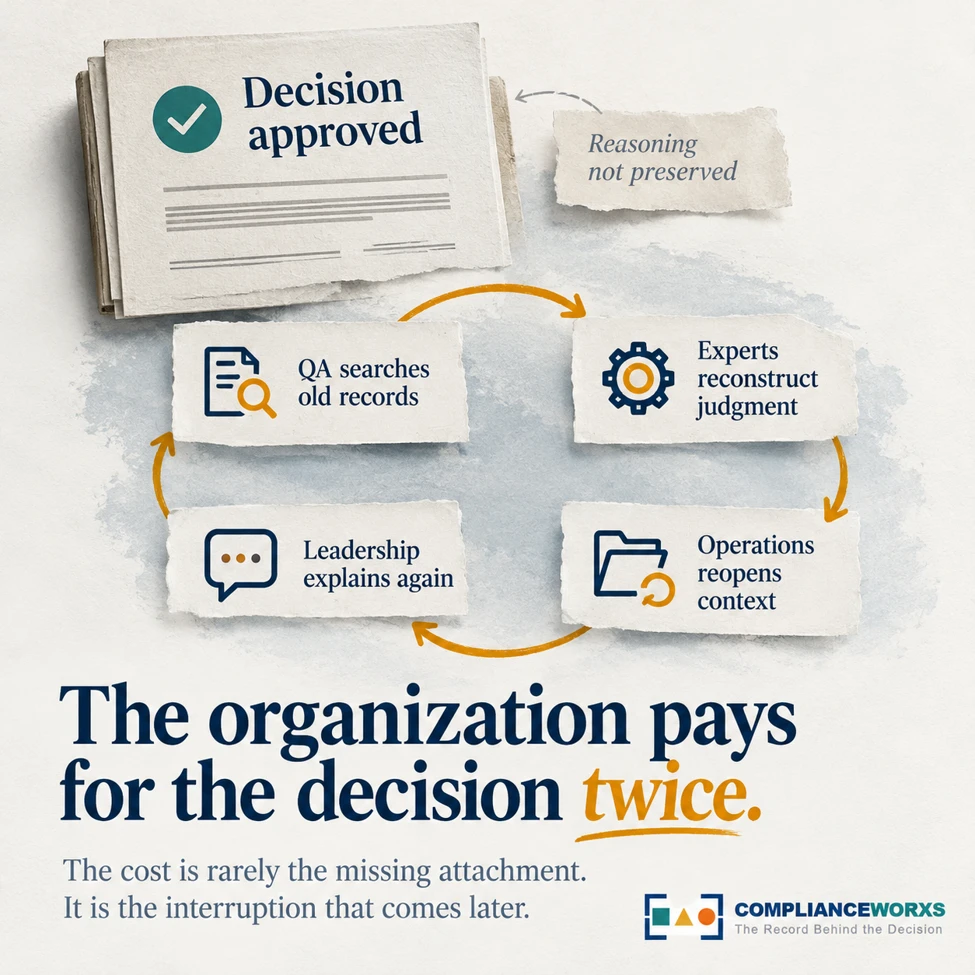
QA searches old records. Technical experts reconstruct their judgment. Operations reopens closed context. Leadership gets pulled back into explaining a decision the organization already made once.
The organization pays for the decision twice:
Once when the decision is made.
And again when its reasoning has to be rebuilt.
Approval is not explanation
This distinction becomes especially important in CAPA.
A CAPA can be approved, completed and closed. The record may show the issue, root cause, corrective action, due date, effectiveness check and final approval.
But a later recurrence can expose a different question:
Why was this corrective action considered sufficient in the first place?
Perhaps retraining and a procedure revision were selected.
Why those actions?
What alternatives were rejected?
What assumptions were made about recurrence?
What residual risk remained?
What evidence made the organization believe the selected action would prevent the underlying failure pattern from returning?
If those judgments were never preserved, the CAPA record can be complete without the decision itself being durable.
Closure does not establish that the selected corrective action was sufficient. It establishes that the record was closed.
The same problem appears in batch release.
A record may say:
Release approved.
That tells a future reviewer what happened.
It does not necessarily explain why release was justified despite contrary evidence, unresolved uncertainty, competing alternatives or residual risk.
Approval is an outcome.
Explanation is the reasoning that made the outcome defensible.
The problem is not lack of information
Most organizations already have plenty of information.
That is not the issue.
The issue is that information is distributed across different sources, created by different people and retained for different purposes.
An investigation record answers one set of questions. A technical assessment answers another. An email may preserve a key judgment. A meeting may contain the rationale for rejecting an alternative. A risk assessment may explain what uncertainty remained. An approval record may identify who had authority.
Each record can be valid on its own.
But no single record may explain the complete decision architecture.
That is why reconstruction becomes necessary.
The decision exists.
The evidence exists.
The reasoning exists.
But it does not exist together.
Preserve the decision architecture
The solution is not another generic compliance document.
It is a decision-specific record that preserves the reasoning while the evidence, judgment and context are still current.
A future reviewer should be able to see, in one place:
- What facts, records, results and observations supported the decision
- What information pointed in another direction or complicated the conclusion
- How the evidence was weighed and where expert judgment mattered
- What alternatives were considered and why they were rejected
- What uncertainty remained and why the residual risk was acceptable
- Who made the final decision and what authority they had to make it
For one consequential decision, that record should connect:
- Evidence
- What facts, records, results and observations supported the decision?
- Contrary evidence
- What information pointed in another direction or complicated the conclusion?
- Judgment
- How was the evidence weighed? Where did expert interpretation matter?
- Alternatives
- What other courses were considered? Why were they rejected?
- Uncertainty and residual risk
- What remained unknown? What risk remained after the decision? Why was that risk considered acceptable?
- Authorization
- Who made the final decision? What authority did that person have?
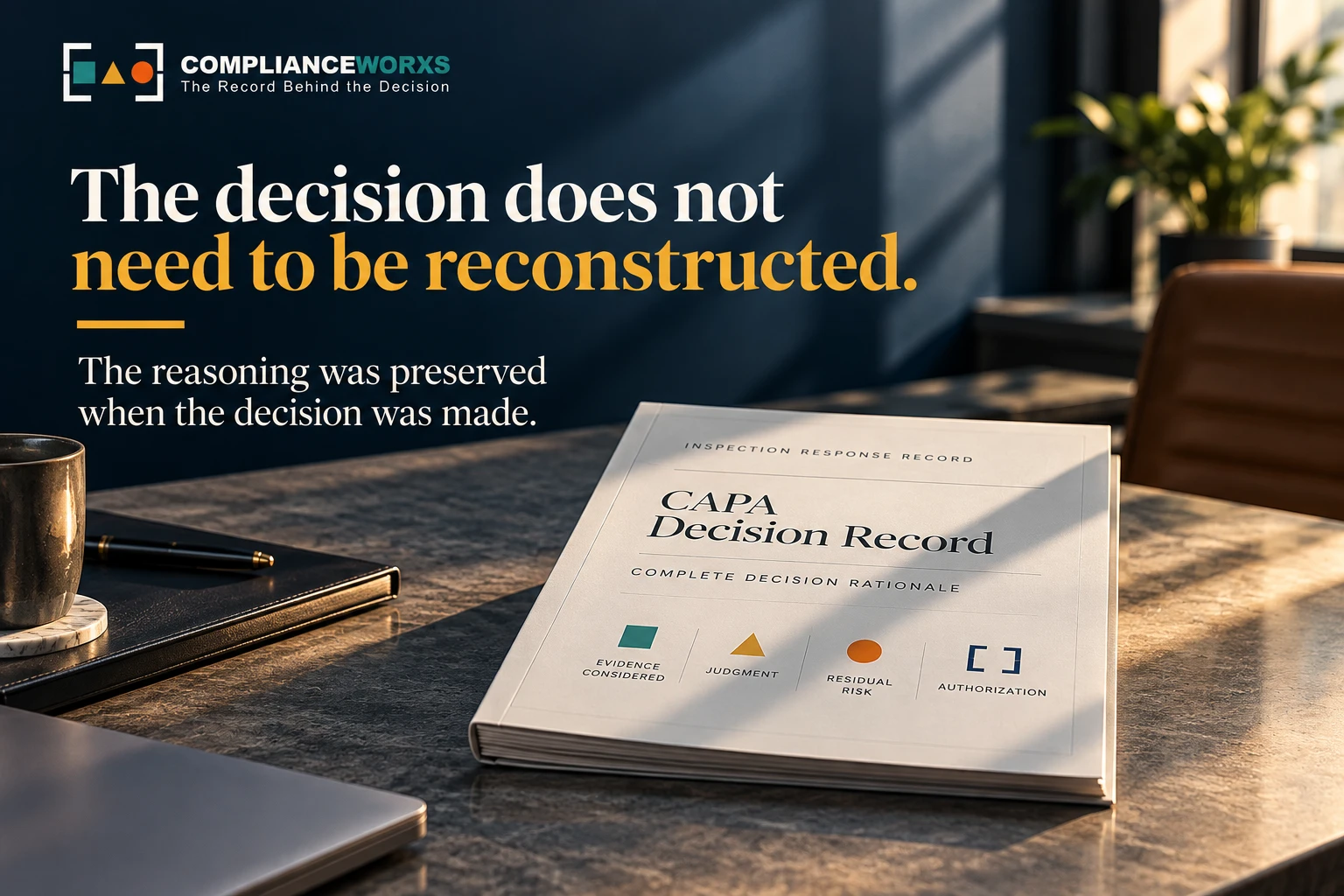
When these elements are preserved together, the organization does not have to recreate the logic later.
The reviewer does not have to infer the reasoning from fragments.
The organization does not have to depend on memory.
The record can stand on its own.
What an Inspection Response Record changes
An Inspection Response Record does not replace the underlying quality records.
It does not duplicate the deviation, investigation, CAPA or batch-release record.
It preserves the reasoning that connects them.
More importantly, it prevents the organization from having to reconstruct that reasoning after the people, context and judgment have dispersed.
Instead of:
Decision made → reasoning scattered → future reconstruction
the organization creates:
Decision made → reasoning preserved → future review
That changes the nature of the work.
A future reviewer can evaluate the decision rather than reconstruct it.
QA can review instead of search.
Technical experts do not have to recreate old judgment.
Leadership does not have to reassemble the story.
The organization pays for the decision once.
The real question
The question is not whether your organization has records.
Most do.
The question is whether one consequential decision can be understood without reopening the entire history around it.
If someone asked today:
Why did this decision make sense when it was made?
Could the record answer?
Could a qualified reviewer understand the evidence, contrary evidence, judgment, alternatives, uncertainty, residual-risk acceptance and authority—without reopening files, searching email, finding former participants or relying on memory?
If not, the problem is already present.
The decision may be documented.
The reasoning is distributed.
And every day that passes makes reconstruction harder.
The solution is to preserve the decision architecture while the evidence, judgment, uncertainty and authorization are still understood.
One consequential decision. One reviewer-ready record.