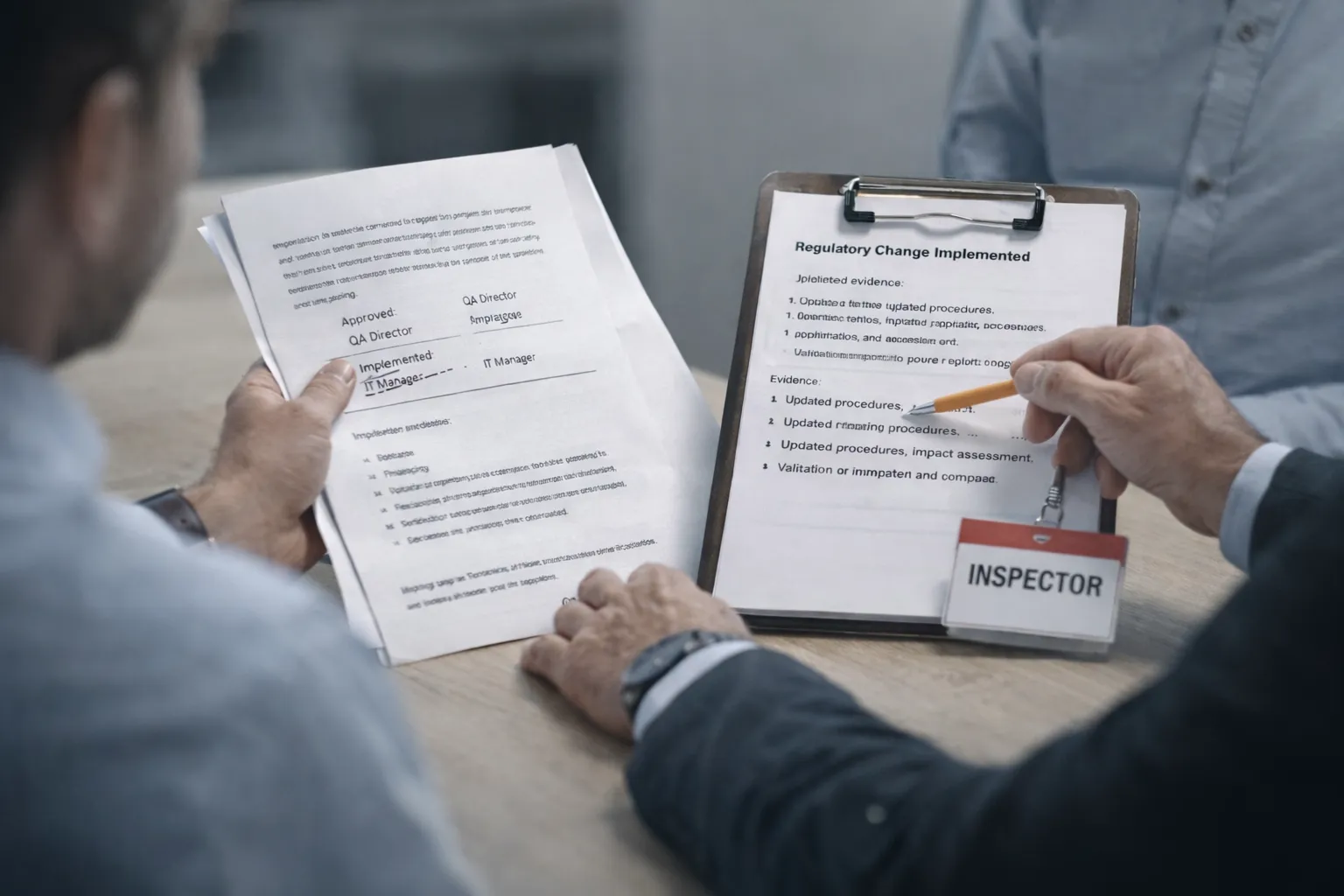
Most inspection readiness work confirms that documents exist. An inspector pulls one consequential decision and asks who authorized it, on what evidence, how the risk was weighed, and why it was justified. This is a test you can run this week.
Answers use this article’s own words and show the section they come from. This is not advice on your own record.
Your question is saved without your name or contact details so we can see what readers want to know. Please leave out names and record details.
A complete set of SOPs, training files, CAPA logs, validation packages, and batch records can still leave one question unanswered: why was this decision made?
The operational gap.
Readiness checks tend to ask a count question. Is the procedure approved? Is training current? Is the CAPA logged? Is the validation package complete? Is the batch record signed?
Those are existence questions. They matter, and an inspector will ask them too.
But an inspector who wants to understand how your quality system actually behaves does not stay with the list. They pick a decision that mattered, a deviation closure, a CAPA closure, a change approval, a batch release, and follow it. The follow-through is where a complete document set stops helping.
The documents show that things happened. They often do not show why a person with authority decided as they did.
The Record Behind the Decision.
That is the category we work in. Every consequential GMP decision leaves two kinds of paper. One records the event: what was done, tested, changed, or released. The other records the decision: what was weighed, what was accepted, and who took responsibility.
The first kind is usually thorough. The second kind is usually a signature, a date, and a short phrase such as “reviewed and approved.”
The regulations point at the second kind. 21 CFR 211.22 gives the quality control unit the responsibility and authority to approve or reject drug products and other materials, and to review production records to assure that errors have been fully investigated. 21 CFR 211.192 requires production and control records to be reviewed and approved by the quality control unit before release or distribution. It also requires that unexplained discrepancies and specification failures be thoroughly investigated, with a written record that includes conclusions and follow-up.
Authority, investigation, conclusions: each describes a decision, not a document type.
The mechanism: four questions, in the inspector's order.
The order matters. An inspector usually starts with authority, because a decision without a clear owner cannot be examined further. Then evidence, then the weighing of risk, then the justification that ties the three together.
2. On what evidence?
What did that person have in front of them when they decided? Can you identify the data, investigation findings, and results they relied on, and tell apart what was available then from what was assembled later?
3. How was risk weighed?
What could go wrong if the decision was wrong, and who or what would be affected? What uncertainty remained, and who accepted it? Silence on this point reads as risk that was never considered.
4. Why was it justified?
What alternatives existed, why were they set aside, and how does the evidence lead to this conclusion? This is the reasoning itself. It is the part most often missing.
Your exercise this week.
This takes one person about an hour. Do not prepare for it.
- Choose one decision. It should be recent, consequential, and already closed. A CAPA closure, a deviation disposition, a change approval, or a batch release will do. Avoid picking the one you already know is well documented.
- Collect only what exists today. Pull the record exactly as it stands in the system. Do not call the decision-maker first to get the story.
- Ask the four questions in order. For each, point to the specific place in the record where the answer is written. If you have to say “well, what happened was,” the record has not answered.
- Mark each answer as present, partial, or absent. Partial counts when the answer can only be inferred from a signature, a title, or a template field.
- Have a second person try it blind. Hand them the record and the four questions without context. What they cannot find, an inspector will not find either.
When the record does not answer.
It will fail somewhere. That is the point of the test, and it is useful information.
The wrong response is to fix it now. Writing a late-dated memo, adding an explanatory paragraph to the closed record, or asking the decision-maker to recall their reasoning and then documenting it as though it were contemporaneous, produces something different from what you started with. A reconstruction is a statement about what someone now believes they must have thought. It is not the reasoning that existed when the decision was made, and an inspector who sees the difference will weigh the rest of your records accordingly.
Backfilling the original record is not the answer. Use your existing procedures for the right way to handle the record itself, and take the question to your Quality unit.
What you can do without touching the closed record:
- Record the finding. Note, through your own quality system, which of the four questions the record could not answer and for which decision.
- Separate what is known from what is recalled. If you must explain a past decision, label any later account clearly as a later account, with the date, author, and sources.
- Check whether the decision itself still stands. A missing rationale is a record problem. It can also signal a decision problem. Your Quality unit decides which.
- Fix the next one. Change what gets captured at the time of decision so the next record answers all four.
What changes going forward.
The fix is small and happens at one moment: when the decision is made. The person with authority writes down, in their own words, the evidence they relied on, the risk they weighed, the alternatives they set aside, and why they decided as they did. Three to five sentences is enough to start. It must be the decision-maker, and it must be then.
That is cheaper than any reconstruction and it is the only version an inspector can treat as the original reasoning.
Source context: Regulatory requirements: 21 CFR 211.22, Responsibilities of quality control unit; 21 CFR 211.192, Production record review. Both were read on eCFR (up to date as of October 7, 2026). The four questions, the ordering, and the illustrative scenario are CW editorial examples, not regulatory mandates.