
ComplianceWorxs Articles · The case described below is fictional and illustrative. It is not a real company decision and not regulatory guidance.
A CAPA can be complete on paper and still leave an important question unanswered: why was the evidence sufficient to justify closure?
Answers use this article’s own words and show the section they come from. This is not advice on your own record.
Your question is saved without your name or contact details so we can see what readers want to know. Please leave out names and record details.
Corrective actions may have been implemented, monitoring completed, and approval recorded. The conclusion may also be reasonable. But another qualified professional should be able to understand how the evidence supports it—and where uncertainty remains.
Much of the discussion about artificial intelligence in pharmaceutical Quality concerns producing and organizing information: drafting documents, summarizing investigations, retrieving records, and reducing administrative work. A different opportunity is to help professionals examine the reasoning connecting that information to a consequential decision.
That is the premise behind ComplianceWorxs Decision Review, an interactive educational experience in ChatGPT built around a fictional CAPA effectiveness and closure case.
The purpose is not to deliver an authoritative answer. It is to create a structured setting in which professionals can question evidence, explore competing interpretations, and explain what makes a conclusion supportable.
A Completed CAPA—and a Question Worth Asking
Consider a fictional manufacturing quality team that has concluded a corrective action was effective.
The actions were implemented as planned. Three consecutive monitoring periods showed no recurrence of the original deviation. The effectiveness check met its stated acceptance criteria, and closure was approved.
Those facts provide a basis for the decision. The next step is to examine how strong that basis is.
What features of the monitoring design support the conclusion? Were there sufficient opportunities for the failure to recur? Did the monitoring address the original failure mechanism? Was the duration justified?
The same observation—no recurrence—can carry different weight in different circumstances. Three monitoring periods might include substantial exposure to the conditions that produced the original problem. They might also include very few opportunities for recurrence.
Neither interpretation should be assumed without examining the context.
The useful distinction is between observing a favorable result and understanding what that result reasonably establishes. A thoughtful review can recognize evidence that supports closure while also identifying limitations that deserve acknowledgment.
It should not presume that the decision was wrong merely because further questions can be asked.
What Interactive Review Adds
A written case can explain the reasoning behind a conclusion. An interactive experience also lets the reader question that reasoning and pursue a different line of inquiry.
In the fictional CAPA case, an exchange might develop like this:
The case reports no recurrence across three monitoring periods.
A reviewer asks: “How many opportunities were there for the failure to recur?”
That question redirects the examination toward production frequency, exposure to the relevant conditions, and the relationship between the monitoring design and the original failure.
This is an illustration of the interaction, not a transcript from a user session.
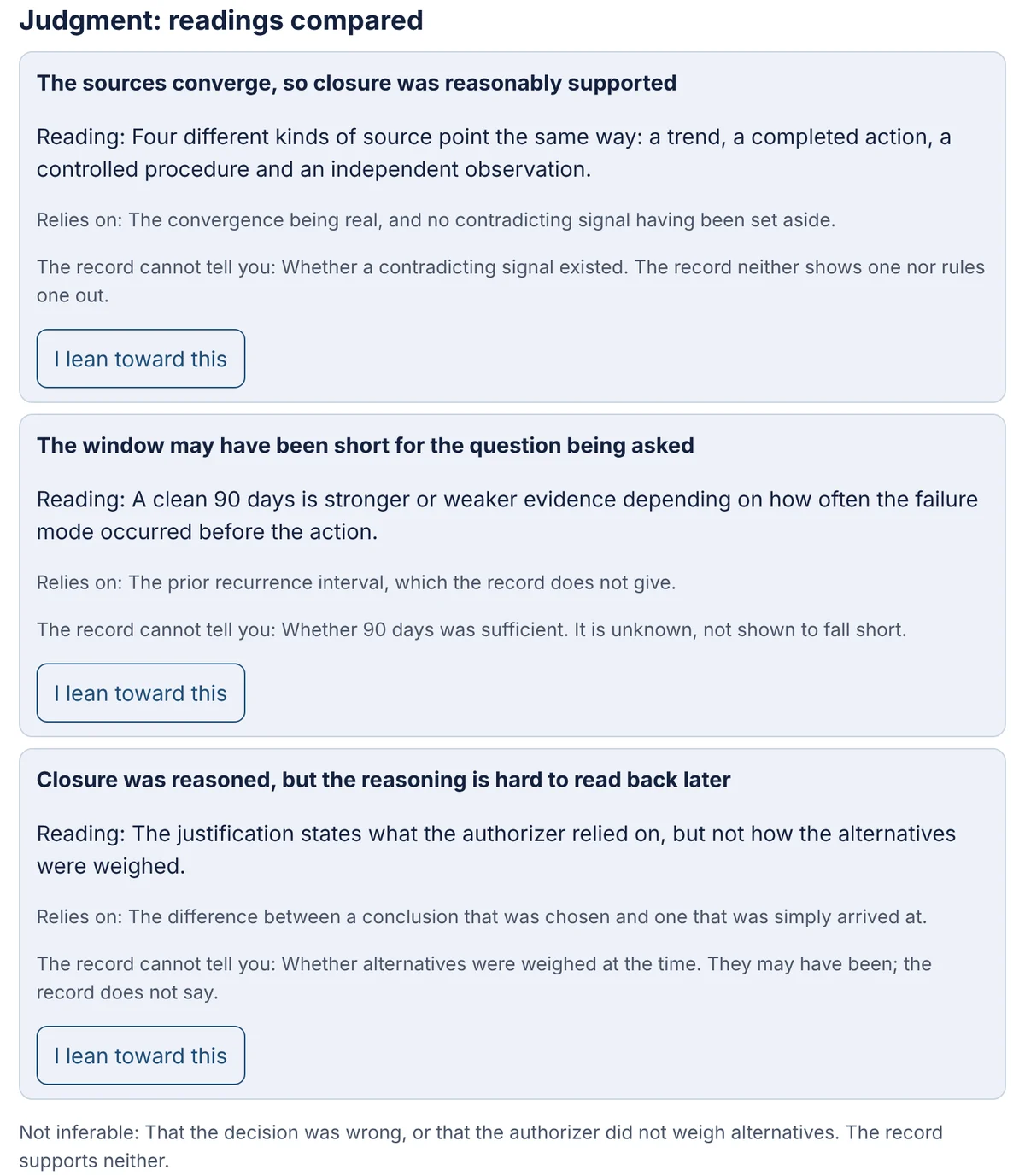
The professional might then ask whether the available information supports closure, supports closure with continued monitoring, or leaves a material question unanswered. They could challenge an assumption, defend the original conclusion, or identify additional information that would change their view.
The value lies in the relationship between the questions and the evidence. The experience should respond to the professional’s inquiry without automatically agreeing with it or manufacturing a deficiency to sustain the conversation.
For an experienced practitioner, that may mean testing a competing interpretation. For someone developing their judgment, it may mean learning to distinguish an observation from the conclusion drawn from it.
Both require more than a fluent explanation. They require clarity about what is known, what is inferred, and what remains unresolved.
Four Elements of a Consequential Decision
ComplianceWorxs structures the examination around four connected elements:
Evidence → Judgment → Risk → Authorization
These are not four independent boxes to complete. Their value comes from examining how they relate to one another.
- EvidenceWhat was known?
- JudgmentWhy was the conclusion reasonable?
- RiskWhat uncertainty remained?
- AuthorizationWho could approve the decision?
Evidence: What was known?
The review begins with the information available when the decision was made.
Was it relevant to the question? How was it obtained? What limitations affected its interpretation? Did it address the applicable criteria and the conditions that mattered?
In the CAPA case, “no recurrence” is an observation. Its significance depends on the monitoring design and the opportunities for recurrence. The examination should distinguish the observation itself from claims about what it proves.
It should also identify when the fictional case does not provide enough information to answer a question.
Judgment: Why was the conclusion reasonable?
Evidence does not always point to a single inevitable conclusion. Professionals interpret it using scientific knowledge, experience, procedures, and the circumstances of the decision.
The review examines that interpretation: which explanation was accepted, what assumptions it relied on, and why alternatives were less persuasive.
Two qualified professionals may disagree without either position being inherently unreasonable. The useful task is to locate the difference. Are they interpreting the same evidence differently? Applying different assumptions? Giving different weight to an uncertainty?
Making those differences explicit is more valuable than forcing agreement.
Risk: What uncertainty remained?
A conclusion can be reasonable without eliminating every uncertainty.
The examination considers which limitations mattered, what consequences could follow, and whether conditions or further monitoring formed part of the decision.
For example, closure with continued monitoring is not the same proposition as closure based on a claim that recurrence is no longer possible. The reasoning and commitments behind each should be clear.
The system can help users explore these distinctions. It does not accept risk on an organization’s behalf.
Authorization: Who could approve the decision?
Authorization requires its own examination.
Does the case identify who approved closure and the procedure governing that approval? Does it provide enough information to understand the person’s authority and the required approval pathway?
Those questions are separate from whether the underlying reasoning was persuasive. An authorized person can approve a poorly explained decision. A well-reasoned recommendation can still require approval from someone else.
Where information about authority is missing, the appropriate conclusion may be that authorization cannot be assessed from the material provided—not that a regulatory violation has occurred.
Together, the four elements help distinguish a weak explanation, an unresolved question, and an unsupported conclusion. They also make room for the opposite finding: that the available evidence and reasoning provide a reasonable basis for the decision.
What the Current Experience Does—and Does Not Do
The initial ComplianceWorxs Decision Review experience uses a fictional CAPA effectiveness and closure case. Users can explore the supporting information, question interpretations, examine uncertainty, and develop their own assessment within a structured conversation.
The current case has completed live integration testing, and the application is being prepared for OpenAI’s public review and approval process. Preparation is not approval; public availability remains subject to that process.
The experience is educational. It does not accept or evaluate actual company records, determine regulatory compliance, or make or authorize GMP decisions.
AI-generated interpretations can also be incomplete, unsupported, or incorrect. A persuasive answer is not verified evidence. Users should be able to trace an interpretation to the information in the case, challenge it, and recognize when a question cannot be answered.
Those boundaries are part of the experience’s purpose. The goal is to support examination—not to present a simulated review as an authorized determination about an organization’s practices.
An Opportunity for Professional Development
Procedural knowledge and decision judgment are related, but they are not interchangeable.
A professional may understand the required steps in a CAPA process and still need practice examining whether particular evidence supports a particular conclusion. They may recognize that uncertainty remains without knowing how to explain its significance to colleagues.
Interactive cases offer a setting in which those skills can be exercised without using an actual company decision.
A developing Quality leader might work through the case by identifying the evidence, proposing a conclusion, and explaining what would change their mind. An experienced practitioner might challenge the case’s assumptions or defend an interpretation the initial discussion did not emphasize.
The same case could also support a team discussion. Differences in interpretation become material to examine rather than disagreements to resolve through seniority or consensus alone.
That does not establish that the experience improves professional competence. Such a claim would require evaluation through use, practitioner feedback, and appropriate learning measures.
The questions worth testing are specific: do participants distinguish evidence from inference more clearly? Do they identify material uncertainty without treating every limitation as disqualifying? Can they better explain why a conclusion is reasonable?
CAPA is a starting point. Potential future cases could apply the same approach to batch disposition, deviation closure, change control, and validation. Those are possible extensions, not capabilities available in the initial experience.
The Standard by Which It Should Be Judged
The opportunity is not simply to place a GMP case inside ChatGPT. It is to give professionals a useful way to examine the relationship between evidence and a decision.
That requires discipline from the application as well as the user. The experience should acknowledge sound reasoning, identify genuine limitations, distinguish unanswered questions from established deficiencies, and resist presenting every discussion as a search for faults.
A signature records approval. It does not, on its own, explain the judgment behind it.
Interactive decision review offers another way to examine that judgment: to question what the evidence establishes, explore reasonable alternatives, and identify what remains unresolved.
Its value should be judged accordingly—not by how authoritative the AI sounds, but by whether the experience helps professionals ask better questions and explain their conclusions more clearly.
Which consequential GMP decision would you most value examining this way—and what would you want the experience to challenge your reasoning?