The Economic Case
The cost of reconstructing a consequential decision is usually paid long after the decision was made.
When the evidence, risk judgment, alternatives, authorization, and reasoning behind a decision aren't preserved contemporaneously, the organization pays for it later — in management time, SME time, retrieval effort, inconsistency, and delay.
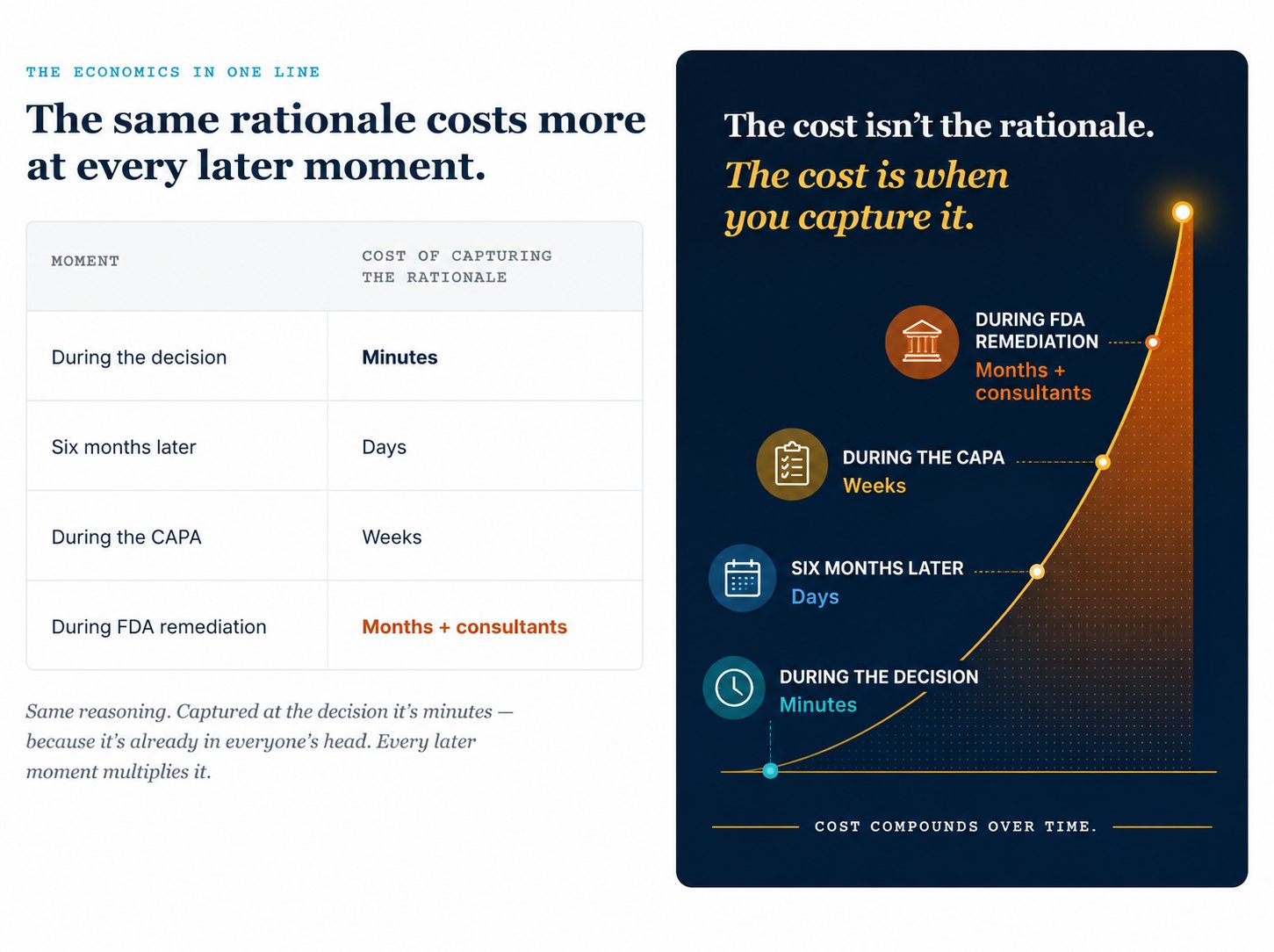
What that last row actually involves
- 01The retrospective review. Comparable decisions across the prior 12–24 months pulled and re-examined, plus a CAPA, effectiveness verification, and an SOP revision.
- 02The reconstruction. Weeks to months of senior QA/RA time rebuilding reasoning that no longer fully exists — backstopped by consultants at $300–500/hr. Six figures is a normal landing spot before anything escalates.
- 03The escalation. Warning letter, consent decree, import alert — and now you're into batch holds and delayed releases. That's revenue, not just labor.
In Practice
One forgotten decision. Eight months later.
Illustrative Reconstruction
Your organization, roughly
Capture those same decisions during authorization instead.
Why this matters
FDA investigators rarely question that a decision was made. They question whether the organization can demonstrate why it was justified.
The Next Step
Your QMS records what was decided. ComplianceWorxs preserves why it was authorized.
A short assessment shows where your organization's decision-record practices are likely to create reconstruction exposure — before an inspection makes that exposure expensive.
Assess Your Decision Defensibility →What the Assessment Measures
Reconstruction cost traces back to five gaps.
The Decision Defensibility Assessment measures whether these are likely present in your current decision-record practices.
1. Reasoning Gap
The record preserves what was decided, not the contemporaneous reasoning connecting evidence, risk judgment, alternatives and authorization.
2. Fragmentation Gap
Material decision context is scattered across records, email, spreadsheets, meetings, systems and individual knowledge rather than preserved with the decision.
3. Context Gap
The formal record fails to preserve the circumstances, constraints, assumptions, alternatives and uncertainty that shaped the decision.
4. Linkage Gap
Records may contain the relevant facts without preserving why a particular finding, risk or conclusion led to the action that was authorized.
5. Continuity Gap
The ability to explain a historical decision remains dependent on the people who participated because the reasoning was not durably preserved.
Already Have a Decision to Preserve
Have a consequential GMP decision being made right now?
The Inspection Response Record preserves the evidence, reasoning, risk judgment, alternatives, and authorization behind one consequential decision — captured while it's still free to capture.
Create an IRR — $497 →Weighed Against Every Alternative
What is the lowest-friction way to preserve the reasoning behind a consequential decision?
Here's the cost of each realistic option — and what it actually buys.
| Option | Typical cost | Produces authorization record | Time to deploy | Ongoing cost |
|---|---|---|---|---|
| Do nothing | $0 | ✕ | Today | Inspection-driven |
| Expand the eQMS | $50k–250k/yr | ✕ | Months | High |
| Ex-FDA consultants | $25k+/engagement | ✕ | Weeks | Variable |
| Add QA headcount | $100k+/yr | ✕ | Months | Annual salary |
| Build internally | $$$ | Eventually | Months | Permanent |
| ComplianceWorxs IRR | $497 | View Sample Record → | Immediately | Optional |
None of these are direct substitutes for each other — an eQMS, consultants, and headcount solve different problems. But none of them, on their own, produce a contemporaneous authorization record for a single consequential decision the way the IRR does. That's a narrow, specific job, priced accordingly. ComplianceWorxs is not a replacement for your QMS, QA team, or consultants.
Before you preserve a decision, ask these questions.
Operational
Sits above your existing QMS — no replacement, no migration, no new system to maintain, no added headcount. Start with one decision; a record takes hours, not a rollout.
Regulatory fit
Structured to meet ALCOA+ attributes. Designed to be maintained within your Part 11 environment — you hold the finished record in your own validated QMS, where your controls apply.
Validation
The qualified person makes and owns the decision; CW structures the record. It's not a system issuing GMP determinations. Apply your risk-based approach; supplier documentation on request.
Vendor & data
The finished record is exportable and yours — stored in your own system. CW isn't your system of record, so vendor continuity never touches records you've already produced.
Procurement & legal
The IRR transacts via Stripe. Governing law: Massachusetts.
Accountability
CW does not make, approve, or recommend regulatory decisions. Those remain the responsibility of the regulated organization and its authorized personnel.
Every organization pays for decision reasoning. The only question is when.
Not sure you're exposed?
Not sure whether your organization is exposed to reconstruction risk?
Have a decision right now?
Have a consequential GMP decision being made now?